Quick Answer
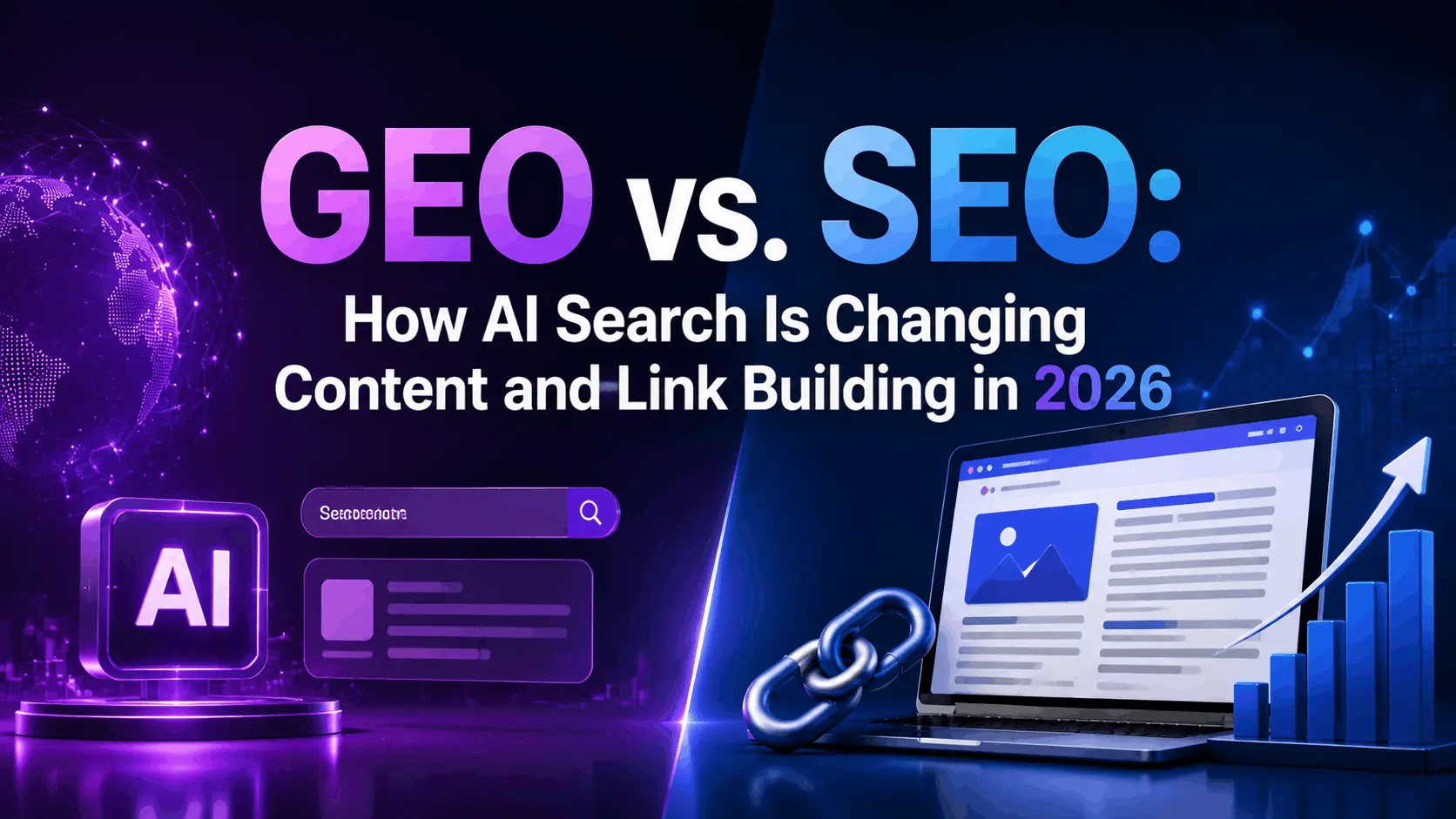
GEO (Generative Engine Optimization) is the practice of structuring content and building authority so that AI platforms like ChatGPT, Gemini, and Perplexity cite or recommend your brand in generated answers, instead of just ranking a page in a list of blue links. It doesn’t replace SEO — it builds on the same foundation of relevance, authority, and trust, with added emphasis on clear structure, entity clarity, and being genuinely citable. Backlinks still matter for both, but brand mentions and entity recognition now carry more weight than they used to.
Why Everyone Is Suddenly Talking About GEO
Search behavior has shifted meaningfully over the past two years. AI Overviews, conversational AI search modes, and standalone AI assistants like ChatGPT and Perplexity have become genuine starting points for research and product discovery, not just novelty features layered on top of traditional search. Industry tracking shows AI Overviews now appearing on a substantial share of Google queries, with continued growth expected.
This shift has created real anxiety for businesses that built their visibility strategy entirely around ranking in a list of ten blue links. If a growing share of searches get answered directly inside an AI summary, without a click to any website, the traditional SEO playbook — rank higher, earn more clicks — starts to feel incomplete. GEO emerged as the industry’s answer to a genuine, structural question: how do you stay visible when the format of “search results” itself is changing.
What GEO Actually Means
Generative Engine Optimization (GEO) is the practice of structuring content and building brand authority so that AI systems choose to cite, mention, or recommend your brand when generating an answer to a user’s question. Unlike traditional SEO, where the objective is a ranking position in a results list, GEO’s objective is inclusion — being one of the sources an AI model draws from and credits when synthesizing its response.
This distinction matters because AI systems don’t work like traditional search rankings. There’s no fixed “position one” to fight for. Instead, AI models retrieve and synthesize information from multiple sources in real time, and being included in that synthesis depends on factors like source reliability, semantic relevance, structural clarity, and how easily your content can be understood and verified.
Read More: Digital PR vs. Guest Posting: Which Link Building Strategy Wins in 2026?
GEO vs. AEO vs. SEO: Untangling the Terminology
The terminology in this space is genuinely unsettled, and even major search engines don’t draw sharp, consistent lines between the terms. That said, a practical working distinction looks like this:
- SEO (Search Engine Optimization) — optimizing to rank pages in traditional search engine results lists, measured primarily by rankings and organic clicks.
- AEO (Answer Engine Optimization) — optimizing content to be extracted and presented as a direct answer, whether in a featured snippet, a voice search response, or an AI-generated summary. AEO is the broader umbrella covering “being the chosen answer” across formats.
- GEO (Generative Engine Optimization) — a narrower focus specifically on being cited, mentioned, or recommended within generative AI responses from platforms like ChatGPT, Gemini, Claude, and Perplexity.
In practice, these three disciplines share the same foundation — clarity, structure, authority, and trust — and most practical strategies treat them as complementary layers rather than entirely separate disciplines requiring separate content.
How AI Search Engines Actually Retrieve Content
Understanding GEO requires understanding, at a basic level, how AI search retrieval differs from traditional ranking. Traditional search engines crawl, index, and rank pages using hundreds of signals, then present a ranked list. AI search systems instead retrieve relevant passages from multiple sources in real time, evaluate them for relevance and reliability, and synthesize a response — often without ever surfacing a ranked list to the user at all.
This means AI systems are looking for content that is:
- Easy to extract — clear, direct answers near the top of relevant sections, not buried in long, unstructured introductions
- Semantically well-aligned — content that clearly maps to the specific question being asked, not just broadly related
- Verifiable — content that can be checked against other sources, with clear sourcing and specific claims rather than vague generalities
- Structurally clean — organized with clear headings, definitions, and logical flow that both humans and machines can parse easily
Pages that are slow to load, poorly structured, or built around thin, generic content are far less likely to be pulled into an AI system’s retrieval pool in the first place, regardless of how well they might otherwise rank traditionally.
Do Backlinks Still Matter for AI Search?
Yes — but their role has expanded rather than simply carried over unchanged. A strong majority of SEO professionals surveyed in 2026 report believing backlinks still influence whether a brand appears in AI-generated search overviews, and available research shows meaningful overlap between pages that rank well traditionally and pages cited in AI Overviews.
What’s changed is that brand mentions — citations of your brand name or content, even without an actual hyperlink — appear to correlate strongly with AI search visibility, in some analyses more strongly than backlinks alone. This reflects how AI systems build a broader picture of brand credibility and topical authority across the web, not just through direct links but through the overall pattern of how often and how credibly a brand is referenced.
The practical implication: link building and digital PR that generate brand mentions — even unlinked ones — now carry SEO value on two fronts simultaneously, supporting both traditional rankings and AI search citation potential.
The Zero-Click Reality: What the Data Shows
Zero-click search — where a user gets their answer directly in the search results without clicking through to any website — has grown substantially since AI Overviews launched broadly, with some tracking showing the zero-click rate climbing well above half of all searches, and dramatically higher within AI-specific search modes.
This is a genuine structural shift, not a temporary fluctuation. For businesses whose visibility strategy depends entirely on organic click-through traffic, this trend requires a real strategic response — not panic, but a broadened definition of what “search visibility” actually means. Being the cited, trusted source inside an AI-generated answer has value even without a click, particularly for brand awareness, trust-building, and influencing purchase decisions before a user ever reaches your website.
How Content Needs to Change for AI Search
Adapting content for GEO doesn’t mean abandoning SEO fundamentals — well-structured, authoritative, genuinely useful content remains the foundation for both. But a few adjustments meaningfully improve AI citation potential:
Lead with a direct, extractable answer. Place a clear, concise definition or answer within the first 40–60 words of any section addressing a specific question, rather than building up to it through a long introduction.
Use specific names and entities, not vague references. Mention your brand, products, and relevant people by name rather than relying on generic phrasing — this helps AI systems connect your content to recognized entities.
Structure for multiple related questions, not just one. AI search interactions often happen in a sequence — a user asks a follow-up question after the first. Content that anticipates and answers the natural next questions is more likely to surface across an entire AI search journey.
Support claims with specific, verifiable information. Vague, generic statements are less useful to an AI system trying to synthesize a trustworthy answer than specific data, examples, and clearly sourced claims.
Maintain genuine human readability first. Recent guidance from search engines has clarified that artificially chunking content into rigid, robotic segments isn’t necessary — organizing for clear human readability naturally produces the structure AI systems can extract from.
The ReachBranker AI Citation Framework
We apply a four-part framework when structuring content for AI search visibility alongside traditional SEO:
1. Definition Clarity. Every major concept gets a clear, standalone definition early in its section — something an AI system could quote as a complete, accurate answer on its own.
2. Entity Density. Content explicitly names relevant people, tools, companies, and concepts rather than relying on pronouns and vague references, strengthening the content’s connection to recognizable entities.
3. Verifiability. Claims are specific and, where relevant, tied to identifiable data or sources rather than presented as unsupported generalizations.
4. Structural Cleanliness. Clear headings that map directly to real user questions, logical progression between sections, and no walls of unstructured text.
This framework doesn’t replace traditional on-page SEO — it layers on top of it, since well-optimized, well-structured content already satisfies most of what AI retrieval systems are looking for.
Common GEO Mistakes to Avoid
Treating GEO as entirely separate from SEO. The two disciplines share the same foundation of authority, relevance, and trust — chasing “GEO-specific hacks” while neglecting SEO fundamentals tends to underperform a genuinely strong, well-structured content strategy.
Over-fragmenting content into artificial chunks. Breaking content into rigid, robotic segments in an attempt to game AI extraction isn’t necessary and can actually hurt human readability, which remains the foundation AI extraction builds on.
Chasing AI referral traffic as the primary goal. Even heavily cited sources often receive very little direct referral traffic from AI platforms. The realistic value of GEO is brand visibility, trust, and influence earlier in the buying journey — not a new major traffic channel.
Ignoring brand mention building. Focusing exclusively on backlinks while ignoring broader brand mention and citation building leaves real AI visibility potential unrealized, given how strongly brand mentions correlate with AI search presence.
Abandoning proven SEO practices to chase unproven GEO-specific tactics. The safest, most durable approach starts with strong SEO fundamentals — clear structure, authoritative sourcing, genuine expertise — rather than replacing them with speculative, unproven GEO tricks.
How Link Building Fits Into a GEO Strategy
Link building doesn’t become less important in a GEO-focused strategy — its value simply broadens. Editorial backlinks and digital PR coverage that generate genuine brand mentions across authoritative, relevant sites strengthen your entity recognition across the web, which appears to influence AI search citation likelihood alongside traditional ranking signals.
This means guest posting and digital PR campaigns built around genuine relevance and quality — the same standards that protect against traditional spam detection — are also the campaigns most likely to support AI search visibility, since both traditional search and AI retrieval systems are ultimately evaluating the same underlying signal: is this brand genuinely trusted and referenced by credible sources.
Read More: Why Most Backlinks Fail in SEO And How to Fix Them in 2026?
A Practical Example: Restructuring a Page for AI Retrieval
Consider a page originally written to answer “what is technical SEO,” structured the traditional way: a long, scene-setting introduction about the history of search engines, followed by a definition buried three paragraphs in, then a loosely organized list of related concepts without clear headers separating them.
An AI retrieval system scanning that page has to work harder to find the actual answer, and may skip it entirely in favor of a competing page that states the definition plainly in the first sentence. Restructured for both human readability and AI extraction, the same page would open with a direct, one-sentence definition, followed immediately by a short expansion, then move into clearly headed sections — “What Technical SEO Includes,” “Why It Matters,” “Common Technical SEO Issues” — each answering one specific question a reader (or an AI system on a reader’s behalf) is likely to have.
Nothing about this restructuring sacrifices depth or nuance. It simply front-loads the direct answer instead of making the reader (or the AI system) work to extract it from the middle of a paragraph. This is the core practical shift GEO asks for: not less depth, just clearer, more front-loaded structure around each individual question a page addresses.
Expert Tips for Improving AI Search Visibility
– Audit your current AI visibility directly. Query ChatGPT, Gemini, and Perplexity with the questions your customers would realistically ask, and see whether and how your brand appears.
-Build content around full question sequences, not single queries. Anticipate the natural follow-up questions a user would ask after the first, and answer them within the same content or closely linked pages.
-Prioritize your highest-intent pages first. Product pages, service pages, comparison pages, and high-performing blog posts tend to offer the highest return on GEO-focused restructuring effort.
-Track brand mentions, not just backlinks. Monitor how often and where your brand is mentioned across the web, even without links, since this signal increasingly matters for AI visibility.
-Don’t expect stable, permanent citation. AI-cited sources change frequently — month-to-month source rotation in AI-generated answers is common, so consistent, ongoing optimization matters more than a one-time content overhaul.
Conclusion
GEO isn’t a replacement for SEO, and it isn’t a shortcut around the fundamentals that have always mattered: genuine authority, real relevance, and content that’s actually useful to the person reading it. What’s changed is the format search results take and the retrieval mechanics behind them — and that shift rewards businesses that build clear, well-structured, genuinely citable content and back it with real brand authority across the web, through both linked and unlinked mentions. The practical path forward isn’t chasing every new GEO acronym or tactic as it emerges. It’s doing SEO well — with more deliberate attention to structure, entity clarity, and brand mention building than the old “rank and hope for a click” playbook required.
Frequently Asked Questions
Is GEO replacing SEO?
No. GEO and SEO share the same underlying foundation of authority, relevance, and trust. Google itself doesn’t treat AEO and GEO as separate disciplines from broader search optimization — they’re better understood as an extension of SEO for a new retrieval format, not a replacement for it.
Do I need completely different content for GEO versus traditional SEO?
Generally no. Well-structured, genuinely useful, clearly organized content tends to perform well for both traditional rankings and AI citation. The adjustments GEO requires — clearer answers, stronger entity naming, better structure — also tend to improve traditional SEO performance.
How is AEO different from GEO?
AEO (Answer Engine Optimization) is the broader concept of being selected as a direct answer across formats, including featured snippets and voice search. GEO (Generative Engine Optimization) specifically focuses on citation within generative AI responses like ChatGPT and Gemini. In practice, the two overlap significantly and are often used interchangeably.
Does AI search send much referral traffic?
Currently, no — even frequently cited publishers report receiving well under 1% of their traffic from AI platform referrals despite being cited often. The primary value of AI search visibility right now is brand trust and influence, not a significant new traffic source.
How do I know if my brand is being cited by AI search tools?
Directly querying ChatGPT, Gemini, Perplexity, and Google AI Mode with realistic customer questions is the most straightforward way to check, alongside dedicated AI visibility tracking tools that have emerged specifically for this purpose.
Should small businesses worry about GEO yet?
It’s worth starting with SEO fundamentals and structural clarity regardless of business size, since those improvements benefit both traditional and AI search. Dedicated, resource-intensive GEO campaigns are generally more relevant once foundational SEO and content quality are already solid.
Do unlinked brand mentions actually help SEO and AI visibility?
Available research suggests brand mentions correlate meaningfully with AI search visibility, in some studies more strongly than backlinks alone, reflecting how AI systems build a broader picture of brand credibility across many types of references, not just hyperlinks.
What’s the biggest mistake businesses make with GEO right now?
Treating it as an entirely separate, urgent new discipline requiring abandonment of proven SEO practices. The businesses seeing genuine results are extending strong existing SEO fundamentals with clearer structure and stronger entity signals, not replacing their strategy wholesale.