
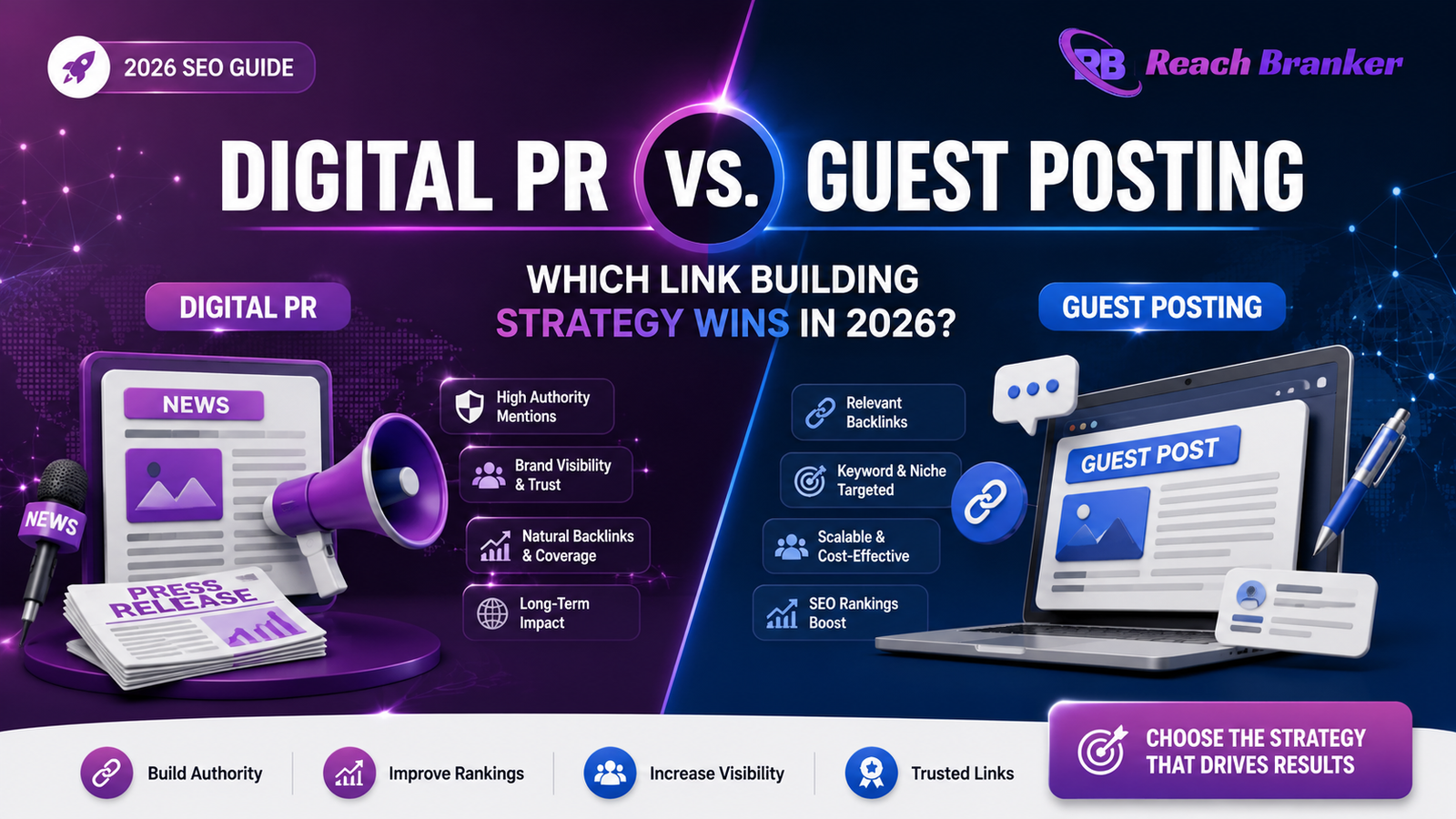
Why This Comparison Matters More in 2026
For years, guest posting was the default answer to “how do I build backlinks.” That’s shifted. Current link building industry data shows digital PR has overtaken guest posting as the tactic SEO professionals most frequently rate as their most effective, driven largely by Google’s increasing sophistication at detecting manufactured, low-effort link placements — a pattern digital PR, by its nature, is far less prone to. That doesn’t make guest posting obsolete. It means the decision between the two now requires a clearer understanding of what each actually delivers, because they solve different problems.
What Is Digital PR?
Digital PR is the practice of earning media coverage and backlinks by pitching original research, data, expert commentary, or newsworthy angles to journalists and publications. Instead of writing content and placing it directly on a target site, digital PR works by creating something genuinely newsworthy — a survey, a data study, an expert reaction to a trending story — and getting journalists to cover it, linking back to your site as the source.
The link isn’t placed by you; it’s earned because a journalist decided your content or data was worth citing. This is what makes digital PR links generally harder to replicate and, in Google’s eyes, harder to distinguish from organic editorial interest — because that’s exactly what they are.
What Is Guest Posting?
Guest posting, covered in depth in our companion guide, is the practice of writing and publishing a full article on someone else’s website, typically in exchange for an author bio and link. Unlike digital PR, you control the content, the target publication (subject to their acceptance), and generally the anchor text and placement within reasonable editorial limits. The trade-off is that guest posting requires actively pitching and placing content on a schedule you control, while digital PR requires creating something compelling enough that journalists choose to cover it on their own.
| Factor | Digital PR | Guest Posting |
|---|---|---|
| Authority Level | Typically higher — major publications, harder to access. | Moderate to high, depending on publisher tier. |
| Control Over Placement | Low — depends on journalist interest. | High — you choose the target website and pitch directly. |
| Typical Cost Per Link | Higher — $500–$1,500+ per placement in competitive niches. | Lower to moderate, depending on publisher quality. |
| Speed to Placement | Slower — usually 4–8 weeks, depending on news cycles. | Faster — typically 2–4 weeks. |
| Scalability | Harder to scale predictably. | Easier to scale consistently. |
| Risk Level | Very low. | Low, if publishers are carefully vetted. |
| Referral Traffic Potential | Often high, especially from major news outlets. | Moderate, depending on the publisher’s audience. |
Cost Comparison
Digital PR generally costs more per link than guest posting, and current industry benchmarks put high-quality backlink costs — factoring in the research, content production, and outreach required — in the range of several hundred to over a thousand dollars per placement for competitive niches. This reflects the real effort involved: producing original research or a genuinely newsworthy story, then pitching it persistently to journalists who receive dozens of pitches daily.
Guest posting costs vary more widely depending on publisher quality, but well-vetted, relevant placements are generally more predictable and often less expensive per placement than digital PR, since the content and outreach process is more standardized.
Neither tactic is “cheap” when done properly. The lowest-cost versions of both — templated guest post marketplaces and mass PR blast services — tend to produce the lowest-quality results, which is where most of the “this doesn’t work anymore” complaints in the industry actually originate.
Read More: Why Most Backlinks Fail in SEO And How to Fix Them in 2026?
Which One Delivers More Authority?
Digital PR links generally come from higher-authority domains than the average guest posting placement, simply because major news and industry publications rarely accept direct guest contributions but do cover genuinely newsworthy stories. A backlink from a well-known publication, earned through digital PR, typically carries more authority signal than a guest post on a mid-tier industry blog.
That said, “average guest post” isn’t the right comparison for high-tier guest posting. A guest contribution placed on a genuinely authoritative, relevant industry publication can rival or exceed the authority value of a moderate digital PR placement — the tiers overlap more than the simple “PR is always better” framing suggests.
Which One Gives You More Control?
This is where guest posting clearly wins. With guest posting, you choose the target publication (subject to their acceptance), control the topic and angle, and generally have input on anchor text placement within the publisher’s editorial guidelines. You can plan a content calendar and know roughly when placements will go live. Digital PR offers far less control. You can craft the most newsworthy angle possible, but ultimately a journalist decides whether to cover it, which outlet picks it up, how they frame it, and whether they include the link you wanted. Some pitches land in major outlets; others land nowhere despite significant effort.
Which One Is Faster?
Guest posting is generally faster to execute predictably. Once a publisher relationship exists or a pitch is accepted, placement typically happens within a few weeks. Digital PR timelines are less predictable — a well-timed pitch tied to a trending story might get picked up within days, while a solid data study might take two months of pitching before it gets meaningful coverage, if it gets covered at all. For businesses that need predictable, plannable link acquisition on a fixed timeline, guest posting’s consistency is a real advantage over the higher-variance outcomes of digital PR.
When to Choose Digital PR
Digital PR makes the most sense when:
- You have (or can create) genuinely original data, research, or a newsworthy angle
- Budget allows for the higher cost-per-link and the possibility that some pitches won’t land
- You’re targeting brand visibility and referral traffic in addition to SEO value
- You want links that are especially difficult for competitors to replicate
When to Choose Guest Posting
Guest posting makes more sense when:
- You need predictable, plannable link acquisition on a schedule
- Your niche doesn’t naturally generate newsworthy angles often
- Budget requires more links at a lower average cost per placement
- You want more direct control over anchor text, topic, and placement timing
Why Most Strategies Should Use Both
Framing this as an either/or choice misses how the two tactics actually complement each other. Digital PR builds high-authority coverage and brand visibility that’s difficult to fake or replicate at scale. Guest posting fills in consistent, controllable link acquisition between PR wins, keeping link velocity steady rather than spiky and unpredictable. A blended approach also diversifies your backlink profile’s source types — a healthy mix of major-publication PR coverage and relevant industry guest contributions looks far more natural to search engines than a profile built entirely from one tactic, regardless of which one it is.
Real-World Scenarios: Which Tactic Fits Which Business
A SaaS startup with an interesting usage-data angle. If your product generates data that reveals something genuinely interesting about how businesses in your space behave, that’s a strong digital PR asset. A study built from anonymized product usage data — “how remote teams actually use project management software in 2026” — is exactly the kind of original angle journalists look for. This business should lean toward digital PR first, using guest posting to fill gaps between campaigns.
An e-commerce brand in a narrow product niche. Niche product categories rarely generate natural news hooks. A leather jacket brand, for example, is unlikely to land in major press through data studies alone. This business is usually better served leaning heavily on guest posting within relevant lifestyle, fashion, and men’s style publications, supplementing with occasional seasonal PR angles (holiday gift guides, seasonal trend commentary) rather than depending on digital PR as a primary channel.
An agency managing multiple client link building programs. Agencies juggling several accounts often benefit from guest posting’s predictability for baseline reporting and client expectations, while reserving digital PR for clients with budget and genuinely newsworthy stories to tell. Mixing both also diversifies the agency’s own case study portfolio across tactics.
A local service business. Local businesses often overlook digital PR entirely, assuming it’s only for national brands. In practice, local and regional press outlets are frequently looking for local business angles — a milestone, a community initiative, or commentary on a local trend — making regional digital PR a lower-cost, higher-relevance option than it might first appear, alongside locally-relevant guest posting on regional business or lifestyle sites.
Measuring Success: Different Metrics for Different Tactics
Because digital PR and guest posting produce different types of outcomes, judging them by identical metrics often leads to premature conclusions about which is “working.”
For guest posting, track:
- Number of live, verified placements per month
- Referring domain diversity (are you spreading across multiple publishers, or concentrated on one or two?)
- Referral traffic per placement, as a signal of genuine publisher audience
- Anchor text distribution, to catch unnatural over-optimization early
For digital PR, track:
- Pitch-to-coverage conversion rate over a full campaign, not a single pitch
- Total unique referring domains earned per campaign
- Brand mention volume, including unlinked mentions
- Domain authority distribution of coverage earned (a few major placements vs. many minor ones)
Judging digital PR by the same monthly placement-count metric used for guest posting almost always makes it look like it’s underperforming, since its outcomes are naturally lumpier and more concentrated around specific campaign windows.
Common Mistakes When Choosing Between Them
Treating them as interchangeable. They solve different problems — assuming one can fully replace the other in every situation misunderstands what each is actually good at. Judging digital PR ROI too quickly. Digital PR has a longer feedback loop and more variance in outcomes; judging it after one or two pitching cycles often leads to abandoning it before it’s had a fair chance.
Over-investing in low-tier guest posting to “save money.” Cheap, mass-market guest posting placements often cost more in the long run through wasted spend on links that provide little to no ranking benefit. Ignoring brand mention value from PR that doesn’t include a direct link. Unlinked brand mentions from PR coverage still contribute to entity recognition and, increasingly, AI search visibility — don’t dismiss coverage just because it lacks a hyperlink.
Building a Combined Budget: A Simple Allocation Model
For businesses trying to decide how to actually split budget between the two tactics rather than choosing one exclusively, a simple starting framework helps: allocate a larger, steady portion to guest posting to maintain consistent link velocity month over month, and reserve a smaller, campaign-based portion for digital PR tied to specific triggers — a product launch, an industry report, a seasonal trend, or a data study.
A business spending, for example, a fixed monthly link building budget might allocate roughly two-thirds to ongoing guest posting placements and reserve the remaining third for a quarterly digital PR push built around one strong angle, rather than spreading digital PR attempts thinly across the entire year. This concentrates the higher-variance, higher-effort tactic into windows where it has the best chance of producing a real result, while guest posting handles the steady baseline in between.
This isn’t a universal formula — a business with a naturally newsworthy product or a strong internal data asset might flip the ratio toward digital PR, while a business in a narrow, low-news niche might lean even more heavily toward guest posting. The principle that holds regardless of the exact split is treating the two as complementary budget lines with different jobs, rather than debating which one deserves the entire budget.
Expert Tips for Combining Both Effectively
- Use guest posting to build the steady baseline, and digital PR to create periodic authority spikes tied to major campaigns or data releases.
- Repurpose digital PR angles into guest post pitches.** A data study that didn’t land major press coverage can often become a strong guest post pitch for an industry publication instead.
- Track brand mentions alongside backlinks. Both tactics contribute to broader entity recognition, which increasingly matters for AI search visibility as much as traditional rankings.
- Budget digital PR in campaigns, not individual placements. Because outcomes are variable, plan and measure digital PR investment across a quarter rather than judging any single pitch in isolation.
Read More: How to Get High Quality Backlinks for Better SEO Rankings
Conclusion
Digital PR and guest posting aren’t rivals competing for the same budget line — they’re complementary tools that solve different link building problems. Digital PR delivers higher-authority, harder-to-replicate coverage but comes with less control and more variance. Guest posting delivers control, consistency, and predictable scaling, at a generally lower cost per placement. The businesses seeing the strongest link building results in 2026 aren’t choosing one over the other. They’re using guest posting to maintain steady, controllable link velocity, and digital PR to periodically create authority spikes that a guest post alone typically can’t achieve.
Frequently Asked Questions
Is digital PR more effective than guest posting for SEO?
Recent industry data shows digital PR rated as the single most effective tactic slightly more often than guest posting, largely due to higher average link authority. Both remain highly effective when executed well; the “more effective” answer depends partly on your niche’s ability to generate newsworthy angles.
Which is cheaper: digital PR or guest posting?
Guest posting is generally less expensive per placement, though high-tier guest posting on genuinely authoritative sites can approach digital PR pricing. Digital PR’s cost also reflects a higher failure rate per pitch, since not every pitch results in coverage.
Can a small business do digital PR without a big budget?
Yes, though it requires either a genuinely compelling story angle or a willingness to invest time in relationship-building with relevant journalists and publications, since digital PR’s cost is largely tied to content research and persistent outreach effort.
Do digital PR links count more than guest post links for SEO?
Search engines don’t explicitly weight tactics differently — they evaluate the resulting link based on the linking site’s authority and relevance, regardless of how the link was acquired. Digital PR links tend to come from higher-authority sites on average, which is why they often carry more weight in practice.
How do I find newsworthy angles for digital PR if my industry is ‘boring’?
Original survey data, industry trend analysis, or expert commentary on breaking news relevant to your industry can all work even in less obviously newsworthy sectors — the angle usually needs to connect your expertise to something the journalist’s audience already cares about.
Should a startup with limited budget start with guest posting or digital PR?
Guest posting is often the more accessible starting point for budget-constrained businesses, since it offers more predictable costs and doesn’t depend on securing press coverage that may or may not materialize.
Does digital PR help with AI search visibility more than guest posting?
Brand mentions and citations from major, well-recognized publications — a common outcome of digital PR — tend to carry strong entity-recognition value for AI search systems evaluating source credibility, though guest posts on genuinely authoritative industry sites also contribute meaningfully.
How many digital PR campaigns should I run per year?
This depends heavily on budget and available newsworthy angles, but running a handful of well-researched campaigns per year, spaced to align with industry events or data cycles, tends to produce more consistent results than infrequent, poorly timed one-off attempts.