
Quick Answer
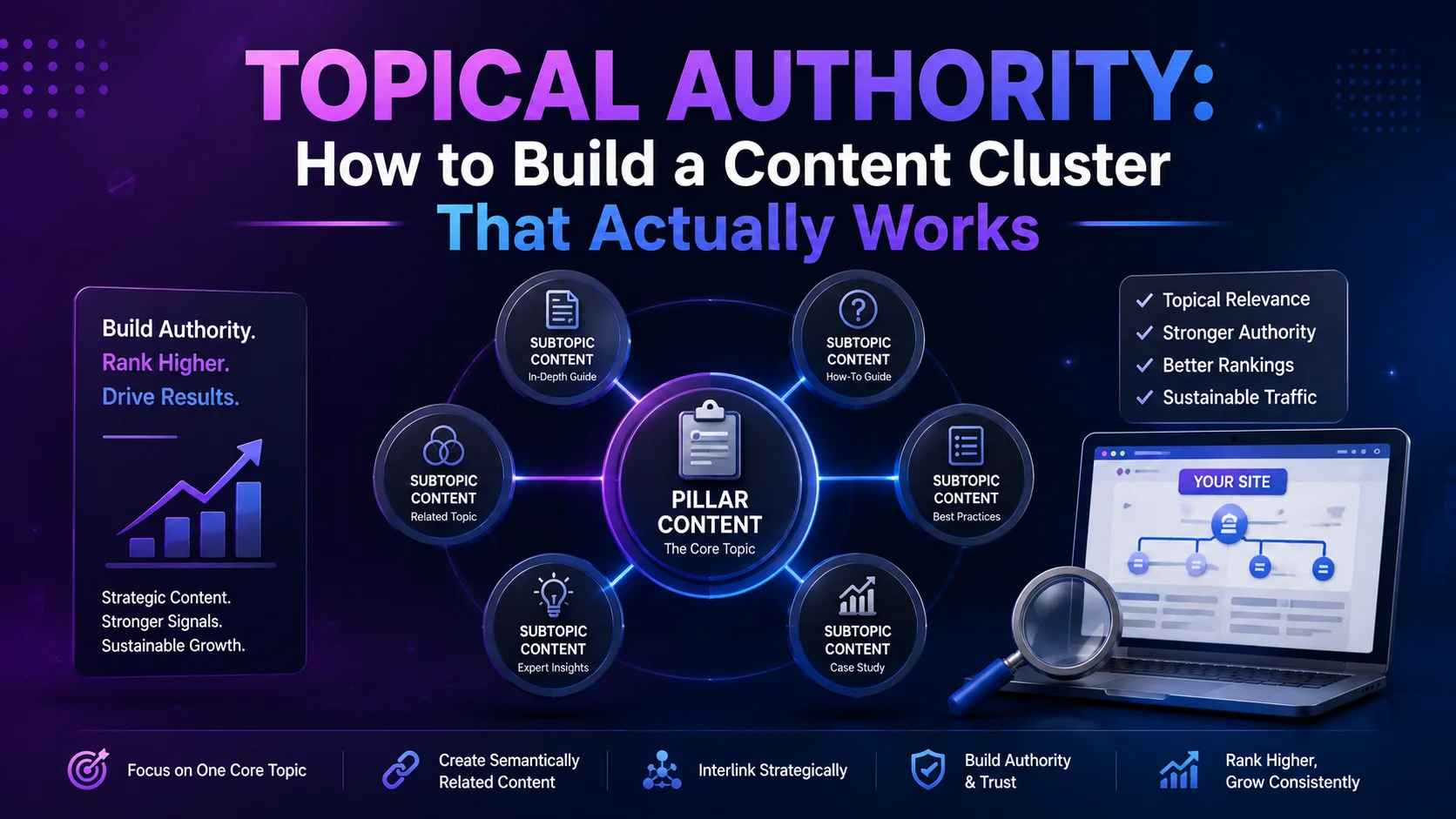
Topical authority is the degree to which a search engine, and increasingly an AI search system, recognizes a website as a comprehensive, trustworthy source on a specific subject, built by covering a topic thoroughly across many connected pages rather than through a single standalone article. A genuine content cluster consists of one central pillar page covering a topic broadly, supported by many narrower cluster articles each covering a specific subtopic in depth, all connected through deliberate internal linking so the structure itself signals comprehensive coverage to both readers and search engines.
Key Takeaways
A single excellent article rarely builds meaningful topical authority on its own, regardless of how well written it is. A genuine cluster requires one pillar page and enough supporting cluster articles to cover the topic’s full range of subtopics and related questions. Internal linking between pillar and cluster content is not optional formatting; it is the mechanism that actually signals topical depth to search engines. Building a cluster in a random order tends to underperform building it in a deliberate sequence, starting with the pillar and highest priority subtopics first. Genuine information gain across each piece in a cluster matters more than simply hitting a target number of published articles.
Read More: Why Reddit Matters for SEO and AI Search Visibility in 2026
Why Individual Articles Rarely Build Real Authority
It is common for a business to publish a genuinely strong, well researched article on an important topic and see disappointing results, then conclude that content marketing simply does not work for their niche. In most cases, the actual problem is not the quality of that single article, it is that a single article, however good, rarely provides enough signal on its own for a search engine to conclude a site is a genuine authority on the broader subject that article belongs to.
Search engines and AI systems alike increasingly evaluate authority at the level of a topic across an entire site, not at the level of a single page in isolation. A site with one great article on guest posting cost sitting alone, with no supporting content on guest posting strategy, checklists, comparisons, or related questions, sends a much weaker authority signal than a site with a coordinated cluster of twenty genuinely useful pieces covering the full range of what someone researching guest posting would want to know.
What Topical Authority Actually Means
Topical authority describes how comprehensively and consistently a website covers a specific subject area, as judged both by search engines analyzing content depth and internal structure, and increasingly by AI systems evaluating whether a site represents a genuinely trustworthy, complete source on a topic. It is built cumulatively, through the combined weight of many related pieces of content, rather than earned through any single page.
A useful way to think about it: if a genuine subject matter expert reviewed your entire site’s content on a given topic, would they conclude you have covered the subject thoroughly, addressed the real questions someone researching it would have, and demonstrated genuine depth rather than surface level coverage. That standard, applied honestly, is a reasonable proxy for what search engines and AI systems are increasingly trying to evaluate as well.
The Anatomy of a Genuine Content Cluster
A properly built content cluster has three components working together.
- The pillar page covers the topic broadly, at a level comprehensive enough to serve as a genuine starting point for anyone new to the subject, while linking out to each of the narrower cluster articles that cover specific subtopics in greater depth.
- The cluster articles each cover one specific subtopic, question, or angle within the broader topic in genuine depth, and link back to the pillar page along with relevant sibling cluster articles where a natural connection exists.
- The internal linking structure connects all of these pieces deliberately, so that both readers and search engines can navigate from the broad pillar into specific depth, and from any specific piece back to the broader context, without dead ends or orphaned content sitting outside the structure entirely.
How to Choose Your Pillar Topic
A genuine pillar topic should be broad enough to reasonably support somewhere between fifteen and forty related subtopics, specific enough that a search engine can clearly understand what the site is an authority on, and directly connected to genuine business value rather than chosen purely because it seems easy to rank for.
A useful test: try listing at least fifteen genuinely distinct questions or subtopics someone researching this topic would want answered. If you struggle to reach even ten without stretching, the topic may be too narrow to support a full cluster and might work better as a single cluster article within a broader pillar instead. If you can easily list forty or more without much effort, the topic may actually be broad enough to split into two or more separate pillar clusters.
Mapping the Full Cluster Before You Write Anything
The single most common mistake in cluster building is starting to publish individual articles as ideas occur, without first mapping the full intended structure. This produces a scattered collection of loosely related content rather than a genuine cluster, and it is far harder to retrofit proper internal linking and structural coherence after the fact than to plan it from the start.
Before writing a single piece, map the complete intended cluster: the pillar topic, every planned cluster article title, and the specific internal linking relationships between them. This map does not need to be published all at once, but it should exist as a complete plan before the first piece goes live, so every early piece is written with its eventual place in the full structure already in mind.
A practical mapping method: write the pillar topic in the center, then brainstorm every genuine question, subtopic, comparison, and related concept someone researching that topic would want covered. Group these into logical categories, which often naturally become your cluster article titles.
The Internal Linking Structure That Actually Works
- Internal linking within a cluster should follow a consistent pattern rather than happening ad hoc as convenient opportunities arise.
- Every cluster article should link back to the pillar page at least once, using natural, relevant anchor text rather than a generic phrase repeated identically across every piece.
- The pillar page should link out to every cluster article, ideally organized under clear subheadings that mirror the cluster’s logical structure, so a reader landing on the pillar can navigate directly to whichever specific subtopic interests them.
- Cluster articles should link to genuinely related sibling articles where a natural connection exists, rather than forcing artificial links between loosely related pieces simply to increase internal link count.
- New cluster articles should be added to the pillar page’s internal links promptly upon publication, since a growing cluster with inconsistent linking back to older or newer pieces undermines the coherent structure the whole approach depends on.
How Many Cluster Articles Is Enough
There is no universal fixed number, since this depends entirely on how broad the pillar topic genuinely is, but a reasonable starting range for most business topics falls between fifteen and thirty cluster articles to achieve genuine, defensible topical depth. Fewer than ten pieces rarely demonstrates enough comprehensive coverage to meaningfully shift how a search engine or AI system evaluates overall authority on the subject.
It is worth emphasizing that quantity alone does not substitute for genuine depth and information gain in each individual piece. Thirty thin, low value articles built purely to hit a number will generally underperform fifteen genuinely thorough, well researched pieces covering the same overall ground. The target article count should guide planning and completeness, not become a goal pursued at the expense of quality in any individual piece.
A Practical Example: Mapping a Real Cluster
Consider a business planning a cluster around guest posting as the pillar topic. A genuine mapping exercise would brainstorm every distinct angle someone researching this topic might need: what guest posting actually is, whether it still works, realistic cost expectations, a checklist for vetting opportunities, comparisons against alternative tactics like niche edits, industry specific approaches for categories such as SaaS or ecommerce, common mistakes, and outreach methodology, among many others.
Once mapped, these naturally group into a logical structure. Foundational pieces answering basic definitional questions belong closest to the pillar page itself. More specific, practical pieces such as a detailed checklist or cost breakdown become individual cluster articles linked from the relevant section of that foundational coverage. Comparison content connecting guest posting to related tactics forms a natural bridge linking this cluster to adjacent clusters covering those other tactics directly, reinforcing the site’s overall topical authority across the broader subject rather than treating each cluster as fully isolated from every other.
This mapping exercise, done properly before any writing begins, typically takes a few focused hours but saves considerably more time later by preventing the scattered, retrofitted structure that results from publishing reactively without a plan.
Read More: AEO Explained: How to Get Your Content Cited by ChatGPT, Gemini, and Perplexity
A Practical Method for Building Your First Cluster
- Step one, select your pillar topic using the test described earlier, confirming it can genuinely support fifteen or more distinct subtopics.
- Step two, brainstorm and organize every subtopic, question, and related concept into a complete cluster map before writing anything.
- Step three, publish the pillar page first, even in a slightly less complete form initially, since it will need to be revisited and expanded as cluster articles are published and linked into it over time.
- Step four, publish cluster articles in priority order, generally starting with whichever subtopics have the clearest, highest value search intent and business relevance, rather than in an arbitrary order.
- Step five, update the pillar page’s internal links immediately as each new cluster article goes live, keeping the structure consistently connected rather than allowing it to fall behind the growing content.
- Step six, review the complete cluster periodically once most planned pieces are live, checking for genuine gaps, outdated information, and opportunities to strengthen internal linking further as the full structure matures.
How Clusters Connect to Each Other Across a Whole Site
A mature content strategy eventually involves multiple clusters covering different pillar topics across a business’s full subject range. These clusters should not exist as fully isolated silos with no connection between them. Wherever a genuine, relevant connection exists between two clusters, such as a piece on guest posting cost naturally relating to a piece on link building budget within a separate but related cluster, a deliberate link between them reinforces the site’s overall topical authority across the broader subject area, not just within each individual cluster.
This cross-cluster linking should remain genuinely selective rather than forced. A link between two clusters should exist because a reader genuinely researching one topic would benefit from the connected piece, not simply because both pieces technically relate to search engine optimization in some broad sense. Overly liberal cross linking between loosely related clusters dilutes the same focused signal that careful cluster building is meant to create in the first place.
Common Mistakes That Undermine Cluster Strategy
Publishing cluster articles without ever building or updating the pillar page they are meant to support, leaving genuinely valuable content structurally disconnected from any broader authority signal.
- Choosing a pillar topic too narrow to genuinely support meaningful cluster depth, resulting in forced, repetitive content that dilutes rather than strengthens topical coverage.
- Treating internal linking as an afterthought added during a final editing pass rather than planned into the structure from the beginning.
- Chasing a target article count with thin, low effort pieces rather than prioritizing genuine depth and information gain in each individual article.
- Abandoning a cluster partway through, leaving an incomplete structure that provides neither the focused value of a single strong article nor the genuine comprehensive authority of a completed cluster.
Expert Tips for Sustained Topical Authority
Revisit and refresh your pillar page every time a significant new cluster article is added, since the pillar should always reflect the current, complete state of the cluster rather than an early, incomplete version. Prioritize subtopics with clear, specific search intent over vague, overly broad subtopics that are difficult to write a genuinely focused article around. Look for genuine gaps by reviewing what a real subject matter expert would expect to see covered, rather than relying purely on keyword tools to identify subtopics. Build clusters around topics genuinely connected to business value, since topical authority on an irrelevant subject provides limited practical benefit regardless of how well built the cluster is. Treat a completed cluster as something requiring ongoing maintenance, not a finished project, since search intent, competitor coverage, and factual accuracy all shift over time.
Conclusion
Topical authority is not built through individual moments of great writing, it is built through the accumulated, deliberately connected weight of comprehensive coverage across an entire subject. A single excellent article is a reasonable starting point, but it rarely produces the authority signal a genuine, well structured cluster of pillar and supporting content can achieve over time.
The method described here is not complicated, but it does require genuine planning discipline before writing begins, and consistent maintenance of the internal linking structure as a cluster grows. Businesses that follow this discipline consistently tend to build durable, compounding topical authority. Businesses that publish content reactively, piece by piece, without ever mapping the full structure, tend to accumulate a large but structurally weak content library that never quite adds up to genuine authority.
Talk to Our Team About Building Your Content Cluster Strategy. Explore Our SEO Content Writing Services.
Frequently Asked Questions
Most websites take 6–12 months to build topical authority. Consistently publishing high-quality cluster content delivers the best long-term SEO results.
Publish the pillar page first. It creates the main hub that supporting articles can link back to as your content cluster grows.
No. A single article can rank well, but true topical authority comes from multiple related articles covering a topic in depth.
Topical authority focuses on depth, relevance, and internal linking, not just publishing a large number of articles.
Yes. Strong topical authority improves visibility in both traditional search engines and AI-powered search platforms.
Publishing 2–4 high-quality articles per month is a consistent and effective pace for building topical authority.
Yes. Each article should target its own primary keyword while supporting the overall topic and linking back to the pillar page.
If your articles link to a pillar page and related content, you have a content cluster. If not, strengthen your internal linking.