Quick Answer
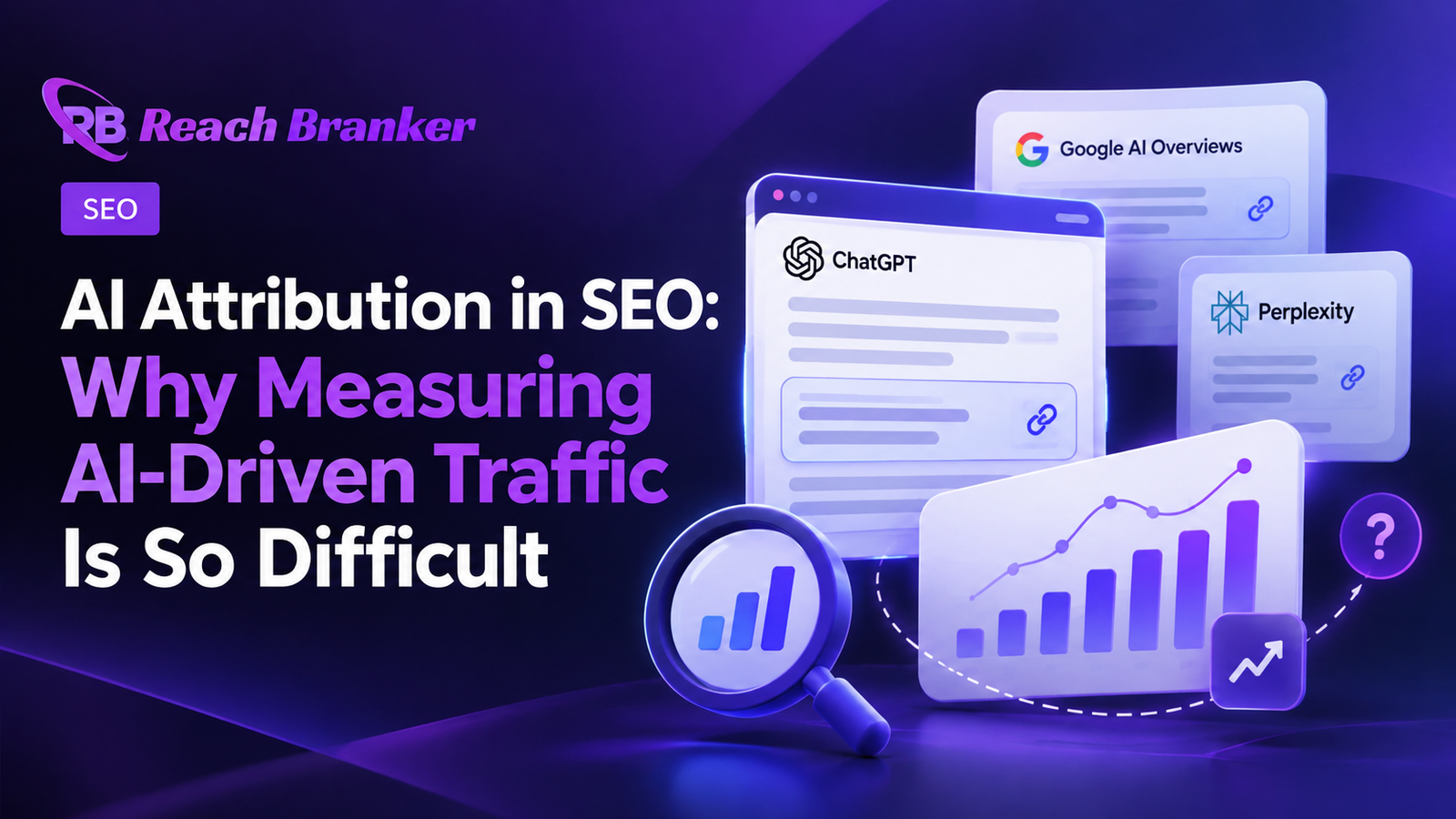
AI attribution in SEO is difficult because AI-powered search platforms influence how people discover businesses without always generating measurable website visits. A user might discover a company through ChatGPT, Google AI Overviews, or Perplexity, then search for its name on Google before visiting the website. Traditional analytics may record that visit as organic or direct traffic, leaving the original AI interaction unrecognized. This creates a gap between AI visibility, referral traffic, and actual conversions. Marketers can improve measurement by combining AI referral data, branded search trends, customer feedback, and conversion tracking. However, no single analytics tool can identify every AI-influenced interaction. The most reliable approach is to measure observable results, investigate indirect signals, and avoid treating estimated AI influence as confirmed traffic.
Key Takeaways
✓ AI visibility does not automatically generate website traffic. A business may appear in AI-generated recommendations without receiving a direct click, making brand exposure difficult to measure through traditional analytics.
✓ AI-driven customer journeys involve multiple platforms. Users may discover a brand through an AI assistant, research it through Google, and return later through another channel, leaving the original discovery source unrecorded.
✓ Traditional analytics cannot capture every AI interaction. Google Analytics and Search Console provide useful information about traffic and search performance, but they cannot reconstruct every conversation that influenced a visitor.
✓ Branded searches can reveal possible changes in brand awareness. An increase in searches for a company name may indicate growing visibility, although other marketing activities can produce similar results.
✓ AI citations and referral traffic require separate measurement. Being mentioned in an AI response does not guarantee that users will visit the cited website or become customers.
✓ Content quality and online credibility remain important. Helpful information, relevant editorial mentions, and a strong website experience support discoverability, but they do not guarantee AI recommendations.
✓ Accurate AI attribution requires multiple data sources. Combining referral sessions, conversions, AI visibility observations, and customer feedback provides a more useful picture than relying on one metric.
Why AI Attribution Has Become a Major SEO Challenge
Traditional SEO measurement has generally focused on search impressions, keyword rankings, website clicks, and conversions. These metrics help businesses understand how users find their websites through search engines and what happens after they arrive.
AI-powered search introduces another layer to that process. People can now ask conversational questions, compare services, and receive business recommendations without immediately opening a website. Some users follow the links included in AI-generated answers, while others continue researching through Google or return to a brand later.
This behavior makes the original discovery source harder to identify. A company may influence a potential customer through an AI recommendation, but the eventual website visit could be attributed to another channel.
For SEO professionals, the challenge is not simply counting visits from AI platforms. It is understanding how AI contributes to awareness, research, and purchasing decisions across an increasingly complicated customer journey.
What Is AI Attribution in SEO?
AI attribution in SEO refers to the process of identifying and evaluating how AI-powered platforms contribute to website discovery, traffic, leads, and conversions.
It attempts to connect interactions with AI-generated answers to measurable business outcomes. These interactions may include a brand recommendation, a cited article, a product comparison, or an answer that encourages someone to research a particular company.
For example, an SEO agency might ask an AI assistant where to find relevant guest posting websites. The response could introduce several marketplaces. The agency may then investigate those businesses through Google before contacting one of them.
Even if the AI recommendation influenced the decision, the final website visit might appear as organic search traffic.
AI Visibility vs. AI Traffic vs AI Attribution
These three concepts are related but should not be treated as interchangeable.
AI Visibility vs. AI Traffic vs. AI Attribution
| Measurement | What It Means | Example |
|---|---|---|
| AI Visibility | How a brand appears in AI-generated responses | A marketplace appears in an AI recommendation |
| AI Referral Traffic | Website visits originating from identifiable AI links | Someone clicks a cited website in an AI answer |
| AI Attribution | How AI interactions contribute to eventual business outcomes | A user discovers a brand through AI and later submits an inquiry |
Why AI-Driven Traffic Is Difficult to Measure
1. AI Platforms Often Answer Questions Without Website Clicks
Traditional search engines usually present results that encourage users to open individual pages. AI-powered interfaces can provide detailed explanations directly within the conversation.
A user researching backlink strategies might receive an explanation covering publisher relevance, anchor text, and link quality without visiting any of the websites referenced in the answer.
The content may influence the user’s understanding, but the website receives no measurable session.
This creates an important difference between being visible in an AI response and generating traffic from that visibility. A citation or recommendation is not the same as a website visit.
2. Referral Information May Be Missing
Analytics platforms use available referral information to help identify where visitors came from. However, that information is not preserved in every situation.
A user might copy a website address from an AI response and paste it into a browser. Another visitor may open a link through an application that does not pass usable referral information.
In these cases, the original AI source may be difficult or impossible to identify through standard website analytics.
However, marketers should not assume that all direct traffic comes from AI. Bookmarks, manually entered addresses, messaging applications, and other sources can also contribute to direct visits.
3. Customer Journeys Include Multiple Touchpoints
A customer rarely makes every purchasing decision after one interaction.
Consider an SEO manager researching guest posting services. They might first ask ChatGPT about publisher selection, compare several marketplaces through Google, read independent articles, and contact a provider a few days later.
The final conversion could be recorded under organic search or direct traffic, even though AI influenced the initial research.
This creates an attribution gap between the first discovery interaction and the measurable conversion.
The problem becomes more significant for B2B businesses, where purchasing decisions often involve extended research, internal discussions, and multiple website visits.
4. AI-Generated Recommendations Are Not Consistent
AI responses can vary depending on the platform, question wording, conversation context, and information available to the system.
A brand appearing in one answer may not appear in another response addressing a similar topic.
For example, asking about guest posting marketplaces generally may produce different recommendations from asking specifically about UK editorial placements.
This variability makes AI visibility difficult to measure through a handful of prompts.
Businesses need consistent testing methods and repeated observations to identify meaningful patterns rather than relying on isolated results.
5. Traditional SEO Tools Cannot Explain Every AI Interaction
Google Analytics can report identifiable traffic sources, user engagement, and conversions. Google Search Console provides information about search impressions, clicks, queries, and website performance in Google Search.
Both tools remain valuable, but neither provides a complete record of conversations across independent AI platforms.
An increase in branded search impressions, for example, may suggest growing brand awareness without identifying exactly where that awareness originated.
Marketers therefore need additional evidence before connecting a traffic increase directly to AI recommendations.
What the Available Data Actually Shows
The main challenge in AI attribution is not simply a shortage of metrics. It is that different metrics describe different parts of the customer journey.
Referral reports can identify certain visits from AI platforms. Search performance reports can reveal changes in branded demand. Conversion tracking can show what visitors do after arriving on a website.
However, these measurements do not automatically establish how the customer first discovered the business.
Suppose a website receives 150 identifiable AI referral sessions during one month. That number represents the sessions its analytics system could associate with those sources. It does not establish that only 150 visitors were influenced by AI.
Other users may have discovered the brand through an AI response and visited through Google later.
Equally, it would be misleading to add unexplained direct traffic to the AI total without supporting evidence.
The most useful interpretation separates confirmed measurements from possible AI influence. This makes reports more transparent and helps businesses avoid overstating the impact of emerging search channels.
How Different AI Platforms Affect Traffic Attribution
Google AI Overviews and AI Mode
Google’s AI search experiences can provide generated answers supported by links to relevant web pages.
These features create opportunities for users to discover information within Google Search, but they also make it harder to distinguish traditional search behavior from interactions influenced by AI-generated responses.
Website owners can evaluate supported Google Search performance through Search Console. However, ordinary search reporting does not reveal every detail of a user’s interaction with an AI-generated answer.
For this reason, changes in Google traffic should not automatically be described as AI-driven growth.
ChatGPT
ChatGPT allows users to explore questions, compare businesses, and investigate services through conversational responses.
When a user follows an identifiable website link, the resulting visit may appear in referral reporting. If the user remembers a business name and visits later through another channel, the earlier interaction may remain invisible.
Businesses can improve their understanding by reviewing detectable referrals and asking customers how they first discovered the brand.
Perplexity and Other AI Answer Engines
Answer-focused platforms can display source citations alongside generated explanations, giving users opportunities to investigate the original information.
These citations may produce measurable website visits, but the number of citations does not directly indicate the number of clicks or conversions.
Marketers should therefore monitor citations and referral traffic separately.
Differences between AI platforms also mean that visibility figures should not be compared without considering how the underlying observations were collected.
How to Track AI-Driven Traffic More Accurately
Monitor AI Referrals in Google Analytics 4
Google Analytics 4 provides a practical starting point for identifying website sessions associated with detectable AI referrals.
Marketers can examine traffic acquisition reports and review session source information to identify visits from relevant AI platforms.
These sessions should be compared with engagement, inquiries, and other meaningful actions.
A small number of highly relevant visitors may contribute more business value than a larger group of visitors who leave without taking action.
Analyze Branded Search Trends
Branded search activity can provide useful context about changes in awareness.
If more people begin searching for a company’s name, marketers can investigate whether new content, AI recommendations, advertising, or other activities may have contributed.
Search Console can help track changes in branded impressions and clicks over time.
However, branded search growth is an indirect signal. It should not be presented as proof of AI influence without additional evidence.
Monitor AI Brand Mentions
Businesses can create a consistent set of questions that reflect what their target audience searches for.
For a guest posting marketplace, these questions might involve identifying relevant publishers, comparing link building services, or understanding editorial placement requirements.
Marketers can periodically test those questions across selected AI platforms and record whether their brand appears.
They should also note how the brand is described and whether a source link is provided.
This process provides a directional visibility record rather than a complete measure of every response shown to users.
Collect Customer Discovery Feedback
Direct feedback can reveal information that analytics reports miss.
A simple question such as “Where did you first hear about our business?” can be included in inquiry forms or sales conversations.
Customers may identify ChatGPT, Google Search, social media, a recommendation, or another source.
These answers are not always perfectly accurate, but they provide another perspective on how potential customers discover a business.
The Practical AI Attribution Checklist
1. Establish a reliable baseline. Record current website traffic, branded search activity, identifiable AI referrals, and conversions before evaluating future changes.
2. Identify relevant AI platforms. Focus on platforms your audience may use rather than attempting to monitor every available AI tool.
3. Create a consistent prompt list. Select questions that represent genuine customer needs and use them repeatedly for visibility observations.
4. Separate citations from referral traffic. Record brand mentions and website sessions independently to avoid confusing visibility with measurable visits.
5. Track meaningful conversions. Monitor qualified leads, contact requests, purchases, or other outcomes that matter to the business.
6. Review branded search performance. Look for sustained changes while considering other marketing activities that may influence demand.
7. Ask customers about discovery sources. Use short surveys or inquiry questions to gather additional attribution evidence.
8. Document measurement limitations. Explain which figures are directly observed and which represent possible influence.
9. Compare results consistently. Use the same reporting definitions each month to identify trends without overstating short-term fluctuations.
How Content, Backlinks, and Guest Posting Fit Into AI Visibility
AI-powered search changes how users discover information, but it does not remove the importance of helpful content and a credible online presence.
Businesses still need accurate information, clear explanations, accessible websites, and resources that genuinely address their audience’s questions.
Helpful Content Supports Discoverability
Content that explains a topic clearly gives users a reason to trust and explore a website.
For an SEO-focused business, detailed guides about publisher relevance, backlink evaluation, and editorial outreach can provide more practical value than generic promotional content.
Original examples, accurate explanations, and clear organization also make information easier for readers to understand.
However, publishing helpful content does not guarantee that an AI platform will cite or recommend it.
Relevant Backlinks Support a Broader SEO Strategy
Backlinks can contribute to traditional SEO and introduce websites to new audiences when they appear naturally within relevant editorial content.
The value of a link depends on its context, relevance, and the nature of the publication.
A genuinely useful editorial mention may generate referral visits and increase awareness among interested readers.
However, backlinks should not be described as a guaranteed method for gaining AI citations. Search visibility and AI recommendations depend on more than the number of links pointing to a website.
Guest Posting Can Expand Brand Awareness
Guest posting provides an opportunity to share useful information with audiences on relevant third-party websites.
For example, an SEO agency publishing an informative article about link building measurement may reach readers who are already researching that subject.
This can support brand discovery and referral traffic when the article offers genuine editorial value.
Businesses should prioritize relevant publications, useful content, and appropriate link practices rather than treating guest posting as a shortcut to AI visibility.
How AI Attribution Differs From Traditional SEO Measurement
Traditional SEO reporting focuses heavily on measurable search interactions, including impressions, clicks, rankings, and conversions.
AI attribution introduces the additional challenge of evaluating interactions that may influence users without producing an immediate website visit.
A search result click creates a clearer connection between the search platform and the website session. An AI recommendation that someone remembers and acts on later may leave no equivalent tracking signal.
This does not make traditional SEO measurement obsolete.
Instead, businesses need to combine established reporting methods with additional observations about AI visibility and customer discovery.
The goal is to understand the wider customer journey without presenting uncertain assumptions as precise attribution data.
Common AI Attribution Mistakes
1. Treating every direct visit as AI-driven traffic. Direct sessions can originate from many sources, and missing referral information does not establish AI influence.
2. Assuming AI citations automatically generate conversions. A brand mention may improve visibility, but it does not prove that users visited the website or completed a valuable action.
3. Relying on one AI platform or prompt. AI-generated responses vary, so isolated tests cannot provide a reliable picture of overall visibility.
4. Ignoring branded search and customer feedback. These signals can provide additional context when direct referral information is incomplete.
5. Measuring traffic without evaluating lead quality. More visitors do not necessarily mean better business results, especially when the audience is not relevant.
6. Presenting estimates as confirmed results. AI attribution reports should distinguish measured sessions from possible indirect influence.
7. Expecting backlinks to guarantee AI recommendations. Relevant editorial links can support broader marketing objectives, but no fixed number of backlinks ensures inclusion in AI-generated answers.
How to Measure Whether Your AI Attribution Strategy Is Working
A useful AI attribution strategy should improve the quality of marketing decisions rather than simply produce another dashboard.
Begin by comparing identifiable AI referral sessions over consistent reporting periods. Review whether those visitors engage with relevant pages, submit inquiries, or complete other valuable actions.
Next, examine branded search trends and AI visibility observations. Look for patterns that appear consistently rather than interpreting every monthly change as meaningful.
Customer feedback can provide another layer of understanding, particularly when buyers report discovering the business through an AI assistant before visiting through Google.
Finally, evaluate whether the combined evidence helps explain changes in qualified leads, customer acquisition, or brand awareness.
A successful measurement process does not require perfect attribution. It requires reliable definitions, transparent reporting, and conclusions that match the available evidence.
Conclusion
AI attribution in SEO is difficult because AI-powered discovery does not always produce a direct, measurable website visit. Customers may encounter a brand through an AI-generated answer, continue researching through traditional search, and convert through a completely different channel.
This creates a gap between brand visibility and the traffic sources recorded by conventional analytics.
Marketers can reduce that gap by combining identifiable AI referrals, branded search analysis, AI visibility monitoring, customer feedback, and conversion tracking. Each source contributes useful information, but none provides a complete record of every AI-influenced interaction.
For businesses investing in SEO, content marketing, and legitimate editorial placements, the priority should remain consistent: publish useful information, build credibility, reach relevant audiences, and measure meaningful business outcomes.
As AI-powered discovery continues evolving, businesses that distinguish observable results from assumptions will be better equipped to evaluate their performance and make informed marketing decisions.
For businesses exploring relevant editorial placement opportunities, ReachBranker provides a marketplace focused on guest posting and publisher discovery.
Frequently Asked Questions
What is AI attribution in SEO?
AI attribution in SEO is the process of understanding how AI-powered platforms such as ChatGPT, Google AI Overviews, and Perplexity contribute to brand discovery, website traffic, leads, and conversions. It helps marketers evaluate the influence of AI-generated recommendations on customer journeys.
Why is AI-driven traffic difficult to measure?
AI-driven traffic is difficult to measure because users may discover a business through an AI-generated answer but visit its website later through Google Search or direct navigation. Traditional analytics cannot always identify the original AI interaction, especially when referral information is missing.
Can Google Analytics 4 track AI referral traffic?
Yes. Google Analytics 4 can identify some website visits from AI platforms when usable referral information is available. Marketers can examine traffic acquisition reports to review identifiable AI referrals, engagement, and conversions. However, GA4 cannot track every interaction that happens before a user visits the website.
Does AI visibility always lead to website traffic?
No. AI visibility means a brand or website appears in an AI-generated response, but users may not click through to the source. A recommendation can influence brand awareness without producing an immediate website visit. AI visibility and referral traffic should therefore be measured separately.
How can businesses measure AI search visibility?
Businesses can monitor relevant questions across selected AI platforms, record brand mentions and citations, analyze identifiable AI referral traffic, review branded search trends, and collect customer discovery feedback. Using several data sources provides a more useful picture than relying on individual prompt results.
Do backlinks and guest posting improve AI visibility?
Relevant backlinks and legitimate guest posting can support broader SEO, referral traffic, and brand discovery. Publishing useful content on appropriate websites may introduce a business to new audiences. However, backlinks and guest posts do not guarantee that AI platforms will mention or cite a particular brand.
What is the best way to measure AI attribution in SEO?
The most practical approach is to combine identifiable AI referral sessions, Google Search Console data, conversion tracking, AI citation monitoring, and customer feedback. Marketers should distinguish directly measured results from possible AI influence and compare performance consistently over time.