Quick Answer
Entity-based link building is the practice of building backlinks with awareness of how search engines understand entities, specific people, organizations, products, and concepts, and the relationships between them, rather than evaluating links purely through keyword matching and anchor text. In practice, this means prioritizing backlinks from sites that are already recognized as genuinely connected to your brand’s topic and industry, and ensuring your own site clearly and consistently identifies the entities it discusses, since search engines increasingly use this relationship data, not just link counting, to judge relevance and authority.
Key Takeaways
Search engines increasingly understand content through entities and their relationships, not just keywords and links in isolation. A backlink from a site already connected to relevant entities in your industry carries a stronger topical relevance signal than a link from an unrelated site with a high metric score alone. Consistent entity naming across your own site strengthens how clearly search engines understand what your brand is actually an authority on. Co-citation, being mentioned alongside other recognized entities in your space, even without a direct link, contributes to entity association in ways traditional link metrics do not capture. Entity-based thinking should influence which sites you pursue for links, not replace the fundamentals of genuine relevance and site quality that have always mattered
Before pursuing entity-aware link building externally, run a quick check on your own site first. Search for your brand name alongside your core topic area and see what results appear, both in traditional search and when asked directly to an AI assistant. Review whether your own content consistently names your key products, services, and concepts the same way across different pages, or whether phrasing varies unnecessarily from page to page. Check whether your site includes basic Organization schema markup at minimum, since this is a straightforward, low-effort step that directly supports how clearly search engines can recognize your brand as a distinct entity in the first place.
What an Entity Actually Means in Search
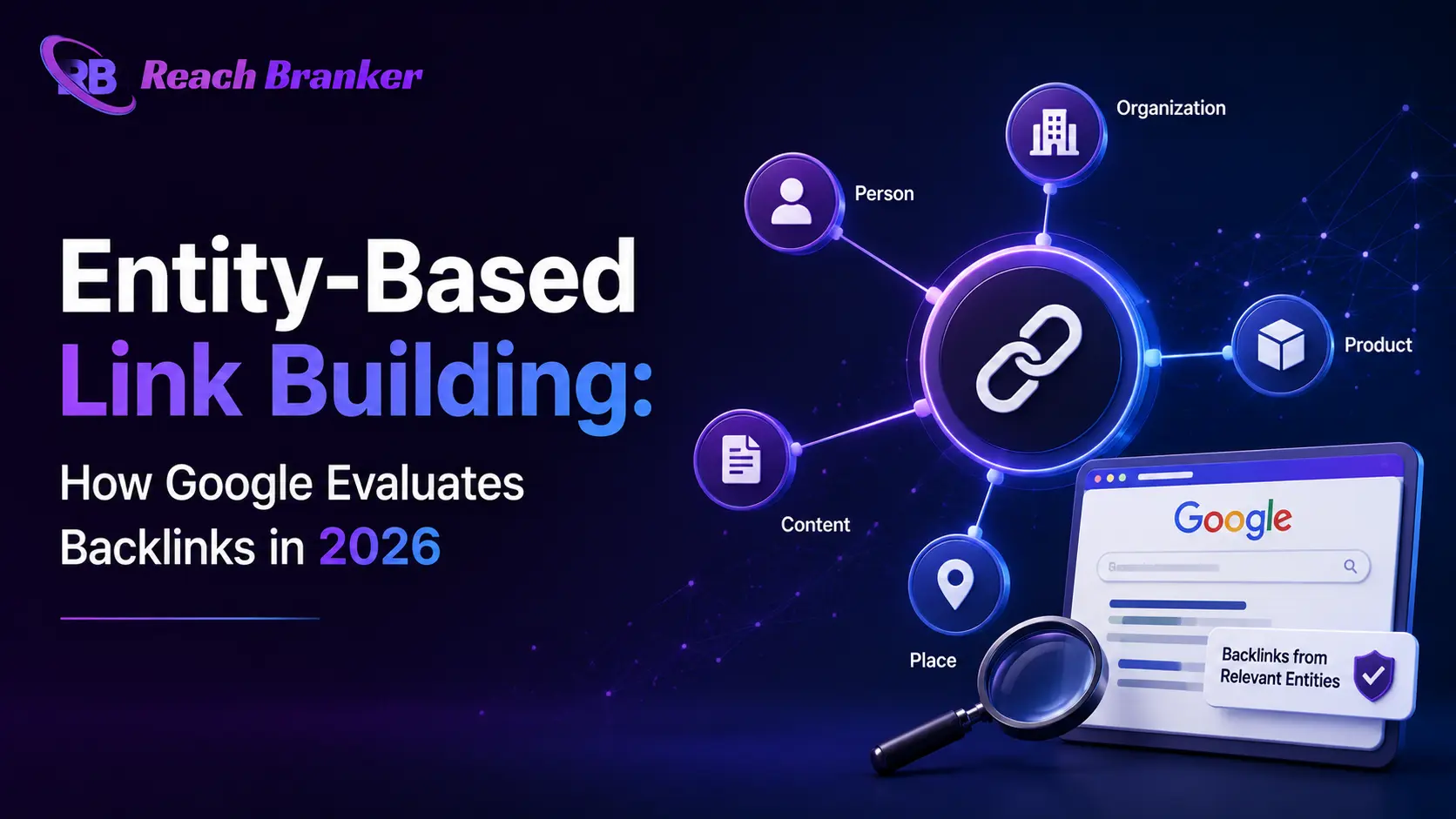
An entity, in the context of search engines, is a distinct, identifiable thing- a specific person, organization, product, place, or concept- that a search engine can recognize, define, and connect to related entities, independent of the specific words used to describe it in any single piece of content. Google’s Knowledge Graph is the most visible example of this system in action, connecting entities like companies, people, and concepts together based on how they relate to each other across the web.
This differs meaningfully from older, purely keyword-based understanding, where a search engine primarily matched the literal words on a page against the literal words in a search query. Entity-based understanding instead asks what specific, identifiable thing this content is actually about, and how that thing relates to other things a search engine already recognizes.
Why Google Moved Toward Entity Understanding
Pure keyword matching has real limitations. The same word can refer to entirely different things depending on context, and the same underlying concept can be described using many different words or phrases. Entity-based understanding helps resolve this ambiguity by connecting content to a specific, defined thing rather than relying purely on literal word matching, which is part of why this shift has continued to deepen across Google’s systems over time.
This shift has practical consequences for link building specifically. A backlink is no longer evaluated purely as a vote from one page to another based on anchor text alone; it can also be understood as a relationship between two entities, the linking site and your brand or content, and how that relationship fits within the broader network of entities Google already recognizes in your industry.
How Entities Change the Way Backlinks Are Evaluated
Under an entity-aware evaluation system, a backlink’s value depends significantly on whether the linking site is itself recognized as genuinely connected to relevant entities in your specific topic or industry, not purely on that site’s overall authority metric in isolation.
A backlink from a site Google already recognizes as topically connected to your industry, through its own established entity relationships, existing content, and citation patterns, carries a stronger relevance signal than a link from a high-authority site with no genuine entity connection to your specific space. This is a more sophisticated version of the relevance principle link builders have generally understood intuitively for years, formalized through the specific mechanism of entity recognition rather than simple topical similarity alone.
How This Connects to Google’s Public Statements on Relevance
Google has repeatedly emphasized relevance and topical fit as central to how it evaluates links, well before entity-based language became common in industry discussion. What entity understanding adds is a more precise, technically grounded mechanism for how that relevance is actually assessed, connecting content not just through shared keywords but through recognized relationships between specific, identifiable things. This gives link builders a more concrete way to reason about relevance beyond intuition alone, evaluating whether a potential link target genuinely sits within an established network of entities connected to your industry, rather than relying purely on a subjective sense that a site feels topically appropriate.
Entity Co-Occurrence and Co-Citation Explained
Two related concepts matter significantly for entity-based link building beyond direct backlinks themselves.
- Entity co-occurrence refers to your brand or product being mentioned near other relevant, recognized entities within the same piece of content, even without a direct hyperlink. If your brand is regularly discussed alongside other recognized, established entities in your industry, this pattern itself contributes to how clearly search engines associate your brand with that specific space.
- Co-citation refers to your brand being referenced or cited alongside other established sources on the same topic across multiple pieces of content, again independent of whether a direct link exists in every instance. A brand consistently co-cited alongside recognized industry authorities builds entity association in a way that traditional backlink counting alone does not fully capture, which is part of why unlinked brand mentions have become increasingly relevant to broader SEO and AI search visibility strategy.
Read More: Guest Posting vs Niche Edits: Which Delivers Better ROI in 2026
Building Your Own Site’s Entity Clarity First
Before pursuing entity-aware link building externally, it is worth ensuring your own site clearly and consistently identifies the entities it is actually about. This means naming your brand, your key products or services, and your core topic areas explicitly and consistently, rather than relying on vague, varying language across different pages.
Structured data markup, particularly Organization and Product schema where relevant, helps search engines explicitly recognize these entities rather than relying purely on inferring them from unstructured text. Consistent naming across your site, using the same specific terms for your key entities rather than varying phrasing purely for stylistic reasons, further reinforces this clarity.
Choosing Link Targets With Entity Relevance in Mind
When evaluating potential link-building targets, entity-based thinking suggests looking beyond a site’s overall authority metric to ask whether that site is genuinely, recognizably connected to your specific industry’s existing entity network. Does the site already discuss, cite, or connect to other recognized entities relevant to your space? Does its existing content demonstrate genuine topical depth in your area, not just occasional, surface-level mentions?
A site that already sits within your industry’s recognized entity network, evidenced by its existing content, its own citation patterns, and its connections to other established entities in your space, offers a stronger relevance signal than a comparably authoritative site with no genuine entity connection to your specific area.
Read More: How to Audit Your Brand’s AI Search Visibility, Step by Step
The ReachBranker Entity Relevance Check
We apply a simple three-part check when evaluating link targets through an entity-aware lens.
- Topical entity presence. Does the target site’s existing content genuinely and consistently discuss entities relevant to your specific industry, not just occasional, tangential mentions?
- Citation network connection. Is the target site itself cited by, or does it cite, other recognized, established entities within your industry, suggesting genuine embeddedness within that space rather than isolation from it.
- Consistency of coverage. Does the target site cover your relevant topic area consistently over time, rather than a single, isolated piece that happens to touch on your industry without broader, sustained topical connection?
- A target passing all three checks offers meaningfully stronger entity-based relevance signal than one passing only on a raw authority metric alone.
A Practical Example: Comparing Two Link Opportunities
Consider a business in the project management software space evaluating two potential guest posting targets. The first is a general business news site with a strong authority metric but a content history covering everything from finance to travel to workplace culture, with only occasional, isolated mentions of project management or software topics specifically. The second is a moderately authoritative site specifically focused on productivity, remote work, and team collaboration tools, consistently publishing content that names and discusses recognized entities within this exact space.
Despite the first site’s stronger raw authority number, the second site demonstrates far stronger entity-based relevance, genuine topical presence, and existing connection to the entity network your brand belongs within. An entity-aware evaluation would favor the second target even at a somewhat lower authority metric, since the relevance signal it offers is likely to carry more meaningful weight than the first site’s broader, less connected authority.
Read More: Crawl Budget Explained: Why Large Sites Waste It and How to Fix It
Common Mistakes When Applying Entity Thinking to Link Building
Treating entity-based link building as an entirely separate discipline requiring abandonment of fundamental relevance and quality principles that have always mattered, rather than understanding it as a more precise, formalized version of relevance evaluation.
Chasing structured data implementation on your own site while ignoring genuine content depth and consistency, when the underlying content quality and topical consistency matter more than schema markup alone.
Ignoring unlinked brand mentions and co-citation opportunities entirely, focusing purely on direct backlinks when broader entity association through mentions and citation patterns also contributes meaningfully to how search engines understand your brand’s position within your industry.
Assuming a single high-authority link from an unrelated entity network provides comparable value to a genuinely relevant link from within your own industry’s recognized entity connections, when the relevance gap between these two scenarios is exactly what entity-based evaluation is designed to detect and weigh differently.
Expert Tips for Building Entity-Aware Backlink Profiles
Audit your own site’s entity clarity first, ensuring consistent naming of your brand, products, and core topics before pursuing external link building with entity relevance specifically in mind. Prioritize link targets that already demonstrate genuine, sustained topical connection to your industry over targets offering only a high authority metric with no clear entity relevance. Track unlinked brand mentions and co-citation patterns alongside traditional backlinks, since both contribute to how clearly search engines and increasingly AI systems associate your brand with your specific industry.
Implement Organization and relevant Product schema markup on your own site to explicitly support entity recognition, treating this as a complement to strong content rather than a replacement for it. Build genuine, sustained topical presence within your industry’s existing content and discussion patterns, rather than treating entity relevance as something achievable through a single isolated tactic or campaign.
A Note on Patience With This Approach
Entity recognition, unlike a single backlink, is not something that shifts immediately after a single action. Search engines build entity association gradually, based on sustained, consistent patterns across many pieces of content and many signals over time. This means entity-based link building rewards a sustained, consistent strategy considerably more than an isolated campaign, and businesses should set expectations accordingly rather than expecting rapid, dramatic shifts in entity recognition from a small number of placements alone.
Conclusion
Entity based link building is not a fundamentally new discipline requiring an entirely different playbook, it is a more precise, technically grounded way of understanding a principle experienced link builders have generally applied intuitively for years, genuine relevance matters more than raw authority metrics. Understanding how search engines actually process entities and their relationships gives you a more concrete, evaluable framework for choosing link targets, auditing your own site’s clarity, and recognizing that unlinked mentions and co-citation contribute meaningfully alongside traditional backlinks.
The practical shift this understanding should produce is straightforward: evaluate potential link targets and your own content with genuine entity relevance in mind, not just a headline authority number.
Talk to Our Team About Entity Aware Link Building. Explore Our Link Building Services.
Finally, it is worth remembering that entity understanding continues to develop within search systems generally, meaning the specific mechanisms described here will likely continue to be refined over time. The underlying principle, however- genuine topical and relational relevance mattering more than isolated metrics- is unlikely to reverse, making it a reasonably safe, durable foundation to build a link building strategy around regardless of how the specific technical implementation continues to evolve.
Frequently Asked Questions
Does entity based link building require completely different tactics from traditional link building? +
No. The same tactics can be used, but entity based link building prioritizes topical and entity relevance when choosing targets and relationships.
How can I check whether a site is genuinely connected to my industry’s entity network? +
Review its content for sustained discussion of relevant entities and check whether it cites or is cited by recognized sources in your industry.
Does structured data markup alone improve entity based link building results? +
No. Structured data helps clarify entities, but genuine content depth, consistency, and external relationships remain essential.
Is entity based link building more relevant for larger brands than smaller businesses? +
No. The principles apply to businesses of all sizes, although smaller brands may need more effort to establish entity clarity and topical presence.
Do unlinked brand mentions really matter as much as backlinks for entity association? +
Unlinked mentions and co-citations can contribute to entity association, while traditional backlinks remain valuable for conventional ranking signals.
How is this different from simply choosing relevant guest posting sites? +
It formalizes topical relevance by focusing on entities and relationships rather than relying only on general judgments of whether a site is relevant.