Quick Answer
There is no single “correct” number, but as a safe operating benchmark: most websites should aim for steady, gradually increasing link growth of roughly 5 to 15% more referring domains per month, scaled to the site’s age, authority, and niche competitiveness. Sudden, unexplained spikes, meaning hundreds of new links appearing in days, remain the clearest trigger for Google’s spam-detection systems. In 2026 those systems are being updated more frequently than ever, with three separate spam updates already released this year, each one completing in under four days. Natural velocity, tied to real content output and real PR wins, is what search engines (and increasingly, AI answer engines) reward.
Key Takeaways
- Link velocity = pace and pattern, not just total backlink count. Google tracks how links arrive, not just how many exist.
- Safe pacing is relative, not fixed. A new blog and an enterprise SaaS site have completely different “normal” growth rates.
- Natural spikes are fine; manufactured, batch-like spikes from low-quality domains are not.
- 2026 has already seen three Google spam updates (March, June, and August), confirming that link-spam detection via SpamBrain is an active, ongoing priority, not a one-time event. Each one rolled out faster than the last: March finished in about 19.5 hours, June in roughly two days and one hour, and August in about two days and sixteen hours, a stark contrast to the 27-day rollout of the August 2025 spam update.
- Both the June and August 2026 spam updates explicitly did not target link spam or the site reputation abuse policy, according to statements Google gave to industry outlets. Link-spam enforcement runs on its own, separate, continuous system regardless of which named spam update just shipped.
- Google clarified in May 2026 that its spam policies also apply to attempts to manipulate generative AI responses in Search, including AI Overviews and AI Mode, widening the scope of what counts as manipulative behavior beyond traditional blue-link rankings.
- Link-based ranking losses are effectively permanent once Google’s systems discount spammy links. Google’s own guidance says recovery, where possible at all, is measured in months as its systems reassess compliance over time, unlike a content-quality penalty, which can lift at the next core update.
- Core updates now weigh people-first, original content more heavily, meaning backlinks alone, however well-paced, cannot compensate for thin or low-value pages.
- Some link churn (loss) is healthy. A backlink profile that never fluctuates can look as unnatural as one that spikes.
- Diversify sources, tie outreach to content output, and monitor monthly referring-domain growth against your own historical baseline and top competitors.
What Is Link Velocity?
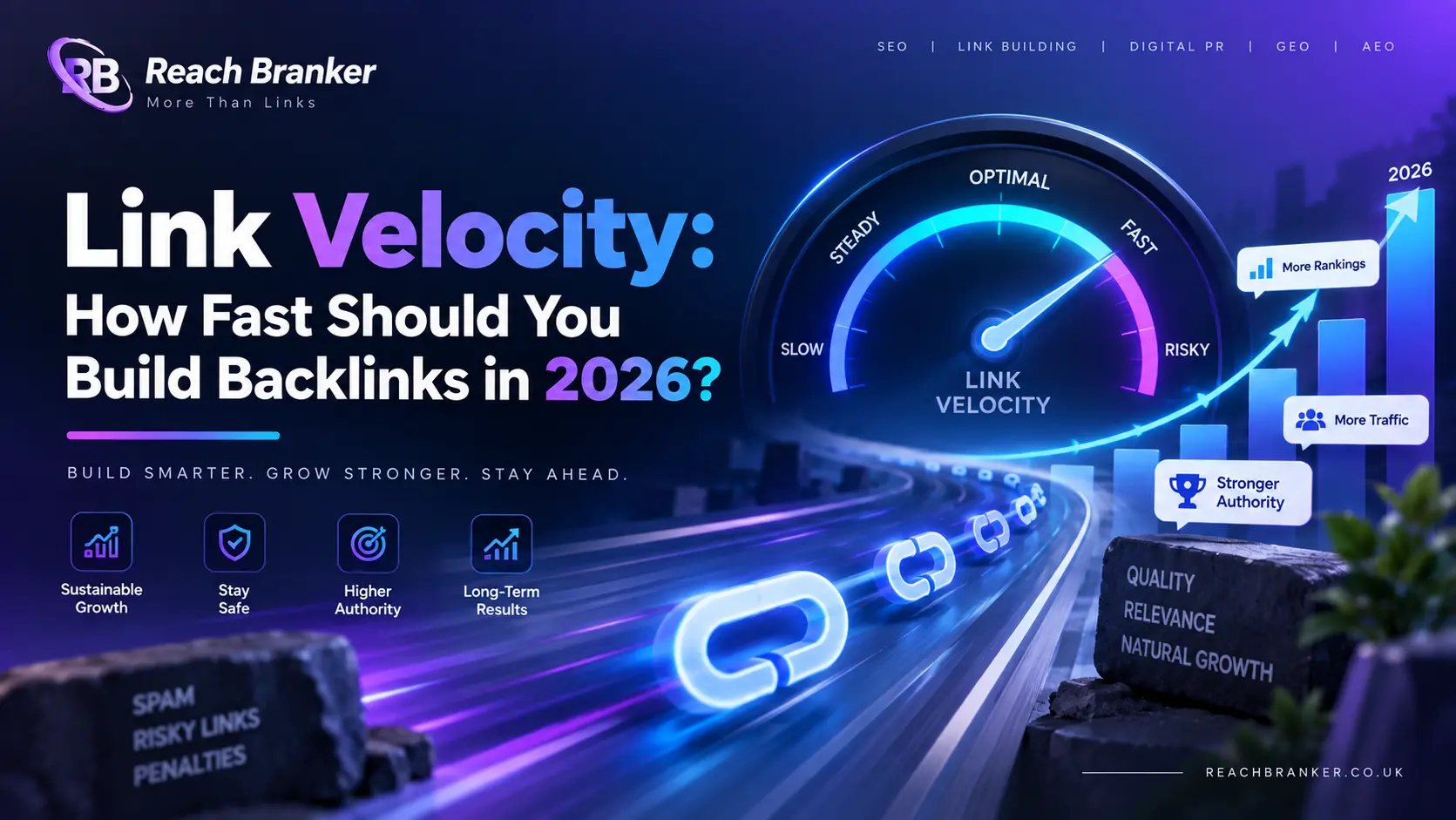
Link velocity is the rate at which a website acquires new backlinks over time. It is a pace and pattern metric, not a volume metric. Two sites can have the exact same total number of backlinks and completely different velocity profiles. A site that earns backlinks in a natural, uneven rhythm, a mix of highs tied to a viral post, quiet stretches between campaigns, and a slow background trickle of citations, looks like a real business building real authority over time. A site that jumps from 10 to 1,000 backlinks in a single week looks like it purchased links or ran a manipulative link scheme, even if every individual link points to a real, indexed page.
Google has never published an exact velocity formula, and it is important to be precise about what is confirmed versus inferred. Google has repeatedly said its automated spam-detection systems, including SpamBrain, its AI-based spam-prevention system, operate continuously and are periodically improved through what it calls “spam updates.” Unnatural link-acquisition patterns, including artificially inflated velocity, fall within the broader set of link spam behaviors these systems are designed to catch.
Why Link Velocity Matters More in 2026 Than Before
Search is changing faster than it has in years, and link velocity sits at the intersection of two 2026 trends worth understanding before you plan any outreach campaign.
1. Spam updates are landing more frequently, and finishing faster
2026 opened with a February Discover-specific core update, followed by the first broad core update of the year in March 2026, and, separately, the first spam update of 2026, also released in March. That update completed in roughly 19.5 hours, the fastest confirmed spam-update rollout on record. It was followed by a June 2026 spam update (roughly two days, one hour to complete), and then a third spam update in August 2026 (about two days, sixteen hours). For comparison, the August 2025 spam update took 27 days to finish rolling out.
The practical takeaway: link-spam detection is not a “set it and forget it” system anymore. It is being actively retrained and redeployed multiple times a year, and each rollout now lands and completes within days rather than weeks. Link patterns that slipped through in early 2025 have a much shorter shelf life in 2026.
2. Not every update targets links, and that matters
When Google announced both the June 2026 and August 2026 spam updates, it told industry outlets the updates did not target link spam and did not target the site reputation abuse policy, clarifying that link spam is handled by a separate detection system on its own independent schedule. Google also declined to name any target for the August update beyond calling it “a normal spam update.”
This is a useful distinction for site owners: if you see a ranking drop after a named spam update, do not automatically assume it is your backlink profile. But do not assume it is not, either, since link-focused enforcement runs continuously in the background regardless of which named update just shipped.
3. Google widened its spam policies to cover AI Overviews and AI Mode
In a clarification issued around May 15, 2026, Google confirmed that its existing spam policies also apply to attempts to manipulate generative AI responses in Search, not just traditional organic rankings. That means link schemes, scaled content abuse, and other manipulative tactics are now explicitly in scope whether the goal is a higher blue-link ranking or a citation inside an AI Overview or AI Mode answer.
4. Link penalties do not have a real “recovery” path
Perhaps the most important technical detail for anyone planning link velocity: when Google’s systems identify and discount the effect of spammy links, any ranking benefit those links previously generated is lost, and Google’s own guidance describes recovery as something that unfolds over months as its automated systems reassess a site’s compliance, not something that reverses immediately after cleanup. This is fundamentally different from a content-quality penalty, where improving your pages can lead to recovery at the next core update. With links, there is no comparable quick reset. That asymmetry, where content penalties recover faster and link penalties recover slowly if at all, is exactly why controlling velocity matters more than almost any other single link-building variable.
5. Core updates increasingly reward original, people-first content
Google’s core updates in 2026, including the March 2026 broad core update, have been described as part of a longer-term shift toward advanced quality models that emphasize surfacing original, helpful, people-first content while penalizing automated, ad-bloated pages. The implication for link building is direct: a fast, aggressive link campaign pointed at thin or templated content is now fighting two systems at once, link-spam detection and content-quality scoring, rather than one.
Ideal Link Velocity by Website Stage
| Website Stage | Typical Healthy Pace | Notes |
|---|---|---|
| Brand-new site (0 to 6 months) | 2 to 5 new referring domains/month | Slow and steady; avoid any appearance of bulk buying |
| Growing site (6 to 18 months) | 5 to 15 new referring domains/month | Should track with content output and outreach volume |
| Established site (18+ months) | 10 to 30+ new referring domains/month | Larger sites can absorb bigger spikes tied to PR or viral content |
| Enterprise/high-authority site | 50+ /month, variable | High baseline authority makes moderate spikes look natural |
These are directional benchmarks, not hard rules enforced by an algorithm. The right pace for your site depends on your competitors’ link profiles, your content publishing cadence, and how much genuine media attention you are generating. A local service business and a venture-backed SaaS company with a PR team should never be judged against the same absolute numbers, only against their own trajectory and their direct competitors.
When a “Fast” Link Velocity Is Actually Safe
Not all rapid link growth is risky. Natural spikes happen when:
- A piece of content goes viral or is picked up by major publications in a short window
- You are featured in a press release covered by multiple outlets simultaneously (a funding round, acquisition, or major hire)
- A product launch generates organic, unprompted media coverage
- You run a legitimate digital PR campaign (original data studies, free tools, surveys) that gets editorial pickup
- You appear in a “best of” roundup or industry awards list that other sites subsequently reference
The difference between these and a manipulative spike comes down to source diversity and topical relevance. Fifty links from fifty different, topically relevant, editorially independent domains in one week reads as a genuine PR win. Fifty links from low-quality directories, expired-domain networks, or link farms in the same window reads as manipulation, regardless of how the campaign was privately framed.
Warning Signs Your Link Velocity Is Too Aggressive
- Backlinks arriving in near-identical batches on the same day(s) each month, forming a recognizable cadence
- A high percentage of new links from low-authority, unrelated-niche, or unexpectedly foreign-language domains
- Anchor text over-optimization, meaning exact-match commercial keywords repeated unnaturally across dozens of new links
- Referring domains with thin content, no organic search traffic, or classic link-farm characteristics (sitewide footer links, “resources” pages stuffed with unrelated outbound links)
- A visible cliff-edge drop in velocity right after a paid campaign ends; real organic momentum tapers gradually, while manufactured momentum stops abruptly
- New links concentrated on a small number of commercial pages rather than spread naturally across blog content, resources, and the homepage
How to Build Backlinks at a Safe, Sustainable Pace
1. Tie link building to content output, not to a quota
Publish link-worthy content, original research, proprietary data, free tools, and comprehensive guides, on a consistent schedule. This naturally paces your outreach instead of front-loading dozens of placements into a single sprint. If your content team ships one major asset a month, your link velocity should roughly mirror that rhythm, not a separate outreach calendar disconnected from what you actually publish.
2. Diversify your link sources deliberately
Mix guest posts, digital PR, resource-page mentions, journalist requests (HARO-style platforms), partnerships, sponsorships, and organic citations. A backlink profile built from five or six different acquisition channels is inherently harder to mistake for a single manipulative campaign than one built entirely from, say, guest posts on a rotating list of the same twenty sites.
3. Spread outreach campaigns over weeks, not days
If you are running a scaled outreach campaign, even a completely legitimate one, stagger email sends and follow-ups so placements land over a multi-week window instead of clustering in a 48 to 72 hour burst. Editors reply on their own schedules anyway, so this is often the natural outcome. Resist the temptation to “batch publish” every secured placement on the same day for reporting convenience.
4. Monitor monthly referring-domain growth against your own baseline
Use a backlink tool (Ahrefs, Semrush, Moz, or similar) to track new referring domains month over month. Set an internal alert if growth exceeds roughly 2 to 3x your trailing six-month average without a clear, legitimate cause such as a viral post or a confirmed PR hit. This single habit catches most accidental over-acceleration, whether it comes from an overeager agency, a bulk directory submission tool, or a well-meaning intern.
5. Prioritize relevance over raw volume
A handful of highly relevant, topically aligned, reasonably authoritative links will do more for both rankings and safety than a large batch of low-relevance links acquired quickly. Relevance is also increasingly what AI-driven answer engines weigh when deciding which sources to cite or summarize, especially now that Google has confirmed its spam policies extend to AI Overviews and AI Mode. A topically coherent link profile supports visibility in both traditional search and AI-generated answers.
6. Let some links happen organically, and do not panic when a few disappear
Not every link needs to be manually built. Genuinely useful content earns passive links over time as other writers discover and cite it. This organic trickle is one of the strongest natural-velocity signals a site can have, and it is largely immune to algorithm updates because it is not manufactured. Equally, expect some natural link loss. Site closures, content updates, and general link rot are normal. A profile that only ever gains and never loses a single link across years can itself look statistically unusual.
7. Audit new links quarterly, not just when rankings drop
Waiting until traffic falls to review your backlink profile means you are reacting to damage that, per Google’s own guidance, may take months to reverse even in the best case. A quarterly audit, checking new referring domains for relevance, authority, and anchor text patterns, catches problems while they are still cheap to fix (pausing a campaign, requesting removal, or disavowing) rather than after a spam update has already discounted the links’ value.
How to Measure Your Current Link Velocity
- Export your referring-domain history from a backlink tool for the past 12 months.
- Plot new referring domains acquired per month on a simple line chart.
- Calculate month-over-month percentage change.
- Compare your trend against 2 to 3 top-ranking competitors in your niche for the same period.
- Flag any month where your growth is 3x or more of your trailing six-month average without an identifiable organic cause (viral content, confirmed press coverage).
- Cross-reference flagged months against the dates of known Google spam updates (March 24 to 25, June 24 to 26, and August 18 to 21, 2026) to see whether ranking movement correlates with your own link activity or with a broader, sitewide-unrelated algorithm shift.
Tools for Tracking Link Velocity
You do not need an expensive stack to monitor velocity responsibly. You need consistency. A few practical options:
- Ahrefs / Semrush / Moz Link Explorer: All three offer a “new and lost referring domains” chart out of the box, which is the fastest way to visualize monthly velocity without building a spreadsheet from scratch.
- Google Search Console: While it does not chart velocity directly, its Links report shows top linking sites and can help you spot a sudden cluster of new, unfamiliar domains worth investigating.
- Custom spreadsheet tracking: For smaller sites, a simple monthly export of new referring domains into a spreadsheet, with a rolling six-month average column, is often enough to catch dangerous spikes early without paying for enterprise tooling.
- Alerts and automation: Most backlink platforms support email or Slack alerts when referring-domain growth crosses a set threshold. Configuring one at roughly 2 to 3x your trailing average turns velocity monitoring from a manual chore into a passive safeguard.
Whichever tool you use, the goal is the same: catch a runaway campaign, whether it is your own outreach moving too fast or a negative SEO attack from a competitor, while it is still cheap to address, rather than after a spam update has already discounted the damage.
A Practical Example
Imagine two SaaS companies, both roughly a year old, both publishing one in-depth guide per month.
Company A hires an agency that promises “200 backlinks in 30 days.” The links arrive in three large batches, mostly from low-authority guest-post networks with generic, unrelated anchor text. Rankings spike briefly, then flatten, and after the next spam update, several key pages lose visibility entirely, with no quick recovery path available since the link-driven gains have been discounted and Google’s own guidance points to a months-long reassessment period rather than an immediate reset.
Company B invests the same budget in one original data study, pitched individually to relevant journalists and industry blogs over six weeks. The links land unevenly, with a cluster after the initial pitch and a slower trickle as writers reference the data in later articles, but every referring domain is topically relevant. Six months later, Company B’s link profile is smaller in raw count but has grown steadily and survived every subsequent spam update without incident.
The lesson is not that Company B “beat the algorithm” through a clever trick. It is that Company B’s link growth reflected genuine editorial interest, which is precisely the signal both traditional ranking systems and newer AI-quality models are designed to detect and reward.
Common Myths About Link Velocity
- Myth: “Faster is always better.” Reality: Speed without relevance and diversity increases risk without proportional reward, and in 2026’s environment of faster, more frequent spam updates, that risk window is shorter than it used to be.
- Myth: “There’s a fixed ‘safe number’ of links per month.” Reality: Safety is relative to your site’s authority, niche, and competitive link landscape, not an absolute number that applies universally.
- Myth: “Losing links quickly is always bad for velocity.” Reality: A healthy link profile also loses some links over time through site closures, content updates, and general link rot. A total absence of link churn can itself look unnatural.
- Myth: “Link velocity only matters for new sites.” Reality: Established sites are still monitored for sudden deviations from their own historical baseline, and larger sites are not exempt from link-spam discounting simply because of their overall authority.
- Myth: “If Google penalizes my links, I can just clean up the profile and recover right away.” Reality: Per Google’s own guidance, once link-driven ranking benefits are discounted by its systems, recovery, where it happens at all, is measured in months of continued compliance rather than an immediate reversal after a disavow request. Prevention through safe pacing and relevant sources is far more valuable than after-the-fact cleanup.
Conclusion
Link velocity is not a trick to game or a single number to hit. It is a trust signal, and in 2026 that signal is being checked more often and more quickly than ever before, with three spam updates already shipped this year, each one completing in under four days. The sites that stay safe are not the ones that build the most links fastest. They are the ones whose link growth mirrors something real: consistent content output, genuine PR wins, and organic citations that would exist whether or not anyone was tracking velocity at all.
The practical playbook is simple even if the execution takes discipline. Pace your outreach to your content calendar, diversify your sources, let campaigns unfold over weeks instead of days, and check your referring-domain growth against your own baseline every month rather than waiting for a ranking drop to go looking. Because recovery from a link-spam penalty is slow at best, prevention is the only strategy that reliably works. Combine safe, natural velocity with genuinely strong, people-first content, and your backlink profile will hold up not just through the next core or spam update, but through whatever Google (and the AI answer engines increasingly sitting on top of it) rolls out after that.
Frequently Asked Questions
What is a good link velocity for a new website?+
For a new website, 2 to 5 new referring domains per month can be a reasonable starting pace. Link growth should increase naturally as the site publishes more content, earns visibility, and builds authority.
Can building backlinks too fast get you penalized?+
Yes. Sudden spikes in low-quality or irrelevant backlinks can create risk, especially when combined with over-optimized anchor text. A natural and relevance-focused link profile is generally safer than aggressive link acquisition.
How many backlinks per month is too many?+
There is no fixed monthly limit. A healthy number depends on your website’s authority, age, niche, competitors, and historical link growth. Sudden unexplained increases are more concerning than a specific backlink count.
Does link velocity affect SEO rankings directly?+
Link velocity is not a confirmed standalone Google ranking factor. However, unusual backlink growth patterns can contribute to how search engines evaluate the quality, trust, and naturalness of a site’s link profile.
Is it bad to lose backlinks quickly?+
Some backlink loss is normal. It becomes more concerning when a large number of valuable links disappear suddenly, particularly if the loss results in noticeable declines in authority, visibility, or organic rankings.
Can I recover from a link-spam penalty by cleaning up my backlinks?+
Cleaning up problematic backlinks through removal requests or appropriate use of Google’s disavow tool can help address link-related issues. Recovery may take time while Google’s systems reassess the site, and previously gained ranking benefits are not guaranteed to return.
Do AI search tools and AI Overviews care about link velocity?+
There is no confirmed link velocity signal specifically for AI search. However, natural link growth, topical relevance, authority, and trustworthy citations can strengthen the signals that help search and AI systems understand and evaluate a website as a reliable source.