
Quick Answer
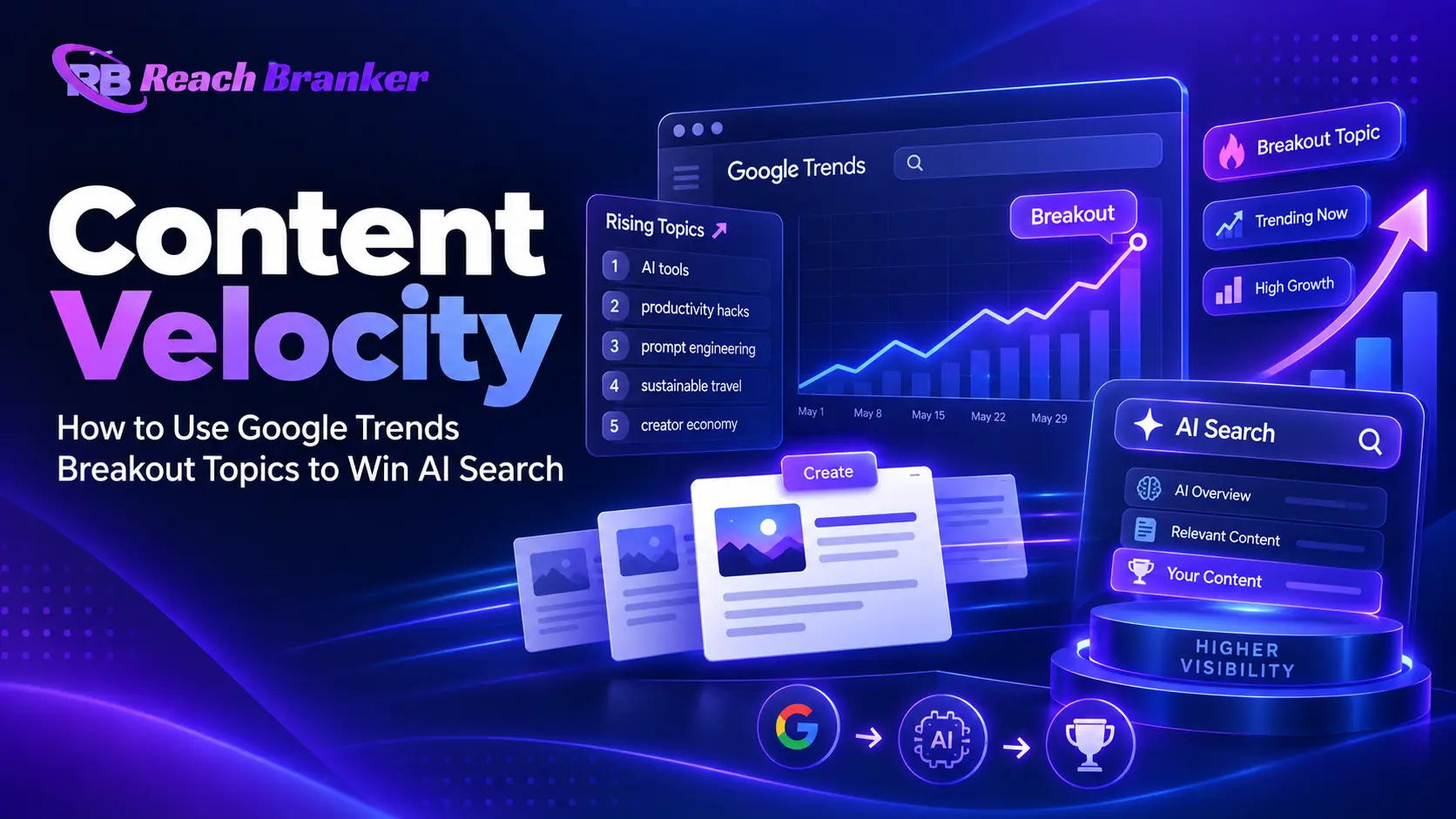
Content velocity is the practice of identifying search terms in their active growth phase, specifically Google Trends “Breakout” topics that have grown more than 5,000% within a given period, and publishing focused, well-structured content while demand is still spiking rather than after it has already peaked. Traditional keyword research tools aggregate data over 30 to 90 days, which means a Breakout term has often already flattened by the time it shows up in standard keyword volume reports. Google Trends now updates its “Trending Now” forecasting engine roughly every 10 minutes, and rebuilt its Explore interface on January 14, 2026 to surface rising and Active trends more prominently. The practical opportunity is not to replace your evergreen content strategy, but to complement it: velocity content earns faster indexing, lower competition, and a real shot at becoming the primary source AI systems cite while a topic is still forming.
Key Takeaways
- A “Breakout” is a specific, defined designation in Google Trends, meaning a search term has grown by more than 5,000% within the selected timeframe, not just an informal label for anything trending.
- Traditional keyword tools are structurally too slow for this strategy. By the time a term accumulates enough historical volume data to appear in standard keyword databases, the growth curve has often already flattened and faster-moving competitors have claimed the freshness advantage.
- Google rebuilt its Trends Explore interface on January 14, 2026, adding a Gemini-powered side panel showing up to eight related terms and doubling the number of rising queries displayed per timeline, making real-time trend spotting meaningfully easier than it was even a year earlier.
- Distinguishing “Active” trends (still growing) from “Lasted” trends (past spikes now declining) is the single most important filtering step, since publishing into a trend that has already peaked captures none of the velocity advantage.
- Velocity content should complement, not replace, your evergreen strategy. A single article, newsletter section, or social post capturing a Breakout topic is low-risk with real upside; rebuilding an entire content calendar around unpredictable spikes is not.
- Content built for AI extraction performs better as velocity content. A concise “mini-answer” paragraph immediately after each heading, paired with clear entity references, is the exact format AI Overviews and featured snippets pull from during a topic’s early, information-scarce phase.
- Reserving roughly 20% of your content calendar as unassigned capacity is what actually makes a velocity strategy executable, since fully-booked editorial calendars cannot react within the narrow window that makes Breakout topics valuable in the first place.
Why Content Velocity Matters in 2026
Search has entered a genuinely different rhythm in 2026. AI Overviews, conversational assistants, and Discover-style feeds all pull from whatever fresh, specific data is available at the moment a query spikes, not only from established, evergreen pages that have accumulated authority over years. When a topic explodes in interest, whether a product launch, a breaking industry development, or a sudden cultural moment, large language models actively seek new information to update their understanding of that topic, and they favor sources that are publishing developing, highly specific coverage over sources offering only static, general background.
This creates a real strategic opening. Breakout topics, by definition, represent high-intent search demand that hasn’t yet been saturated by established competitors, since most competitors are still working from lagging keyword data. The brand that publishes clear, well-structured coverage during the actual growth phase of a topic has a genuine chance to become the primary source that AI systems reference while that topic is still forming, an advantage that’s essentially unavailable once the term has cooled and every major publisher has already covered it.
What a “Breakout” Topic Actually Is?
“Breakout” is not a loose marketing term. Inside Google Trends, it’s a specific, defined designation applied to a rising query that has grown by more than 5,000% compared to the previous period, according to Google’s own Trends documentation. This threshold matters because it filters out ordinary week-to-week fluctuation and isolates genuinely explosive, often newly emerging demand.
These Breakout topics typically represent two distinct opportunities. The first is genuinely high-intent demand with comparatively low competition, since search volume is spiking faster than content supply can catch up. The second is a positioning opportunity: being among the first credible sources to publish structured, specific coverage of a topic while it’s still developing, rather than joining the wave of summary content that inevitably follows once a topic has become mainstream news.
Why Traditional Keyword Research Misses This Window
Most keyword research tools, including the volume estimates built into major SEO platforms, aggregate search data over rolling 30 to 90 day windows. This approach works well for stable, evergreen terms with predictable demand, but it’s structurally unsuited to capturing genuine velocity. By the time a Breakout term has accumulated enough historical data to register meaningfully in these aggregated databases, the actual spike in interest has frequently already flattened, and the “freshness” advantage in both traditional SEO and Generative Engine Optimization has typically already been claimed by whichever publishers moved fastest.
This is the structural gap that a dedicated content velocity approach is built to close: shifting from keyword tools that describe what already happened to a monitoring approach that surfaces what’s happening right now, while there’s still time to act on it.
The Google Trends Explore Rebuild: What Changed
Google rebuilt its Trends Explore page on January 14, 2026, and the changes directly support a faster-moving content velocity workflow. A Gemini-powered side panel now populates the graph view with up to eight related terms automatically, surfacing adjacent angles on a trending topic without requiring separate manual searches. The number of rising queries displayed per timeline also doubled, giving content teams a meaningfully wider view of what’s accelerating around a core topic.
Alongside these interface changes, the “Trending Now” forecasting engine now refreshes roughly every 10 minutes, a genuinely tight window that allows teams monitoring the right topics to publish during what’s often described as the early, “first derivative” growth phase, meaning the point where interest is accelerating but has not yet peaked, rather than after a spike has already been widely covered elsewhere.
Practically, this means the tool itself has shifted from a research aid you check periodically toward something closer to a live monitoring feed, provided your team builds a workflow around checking it that frequently.
Active vs. Lasted: The Filtering Step That Matters Most
Not every trend surfaced by Google Trends is worth acting on, and distinguishing between two trend states is the single most important filtering step in a content velocity workflow. Active trends are still climbing, meaning interest is currently growing and there’s a genuine window to publish before the topic peaks. Lasted trends have already spiked and are now declining, meaning the growth opportunity has effectively closed even though search volume may still look elevated relative to baseline.
Publishing into a Lasted trend captures none of the velocity advantage essentially; you’re competing against every other publisher who already covered the topic during its actual growth phase, without any of the first-mover benefit that made the strategy worthwhile in the first place. Building a habit of checking this classification before committing writing resources to a trending term is what separates a genuine content velocity strategy from simply chasing whatever looks popular at a glance.
The Four-Step Content Velocity Framework
- Step 1: Identify Active Breakout topics connected to your core business. Filter specifically for Active trends, not Lasted ones, and prioritize terms genuinely relevant to your niche rather than chasing broad viral topics with no connection to your expertise or audience.
- Step 2: Build the topic’s semantic context immediately. As soon as a relevant Active Breakout term is identified, research what entities, related concepts, and sub-questions search engines and AI systems already associate with it, even if the topic is only hours old. This context is what allows your content to read as genuinely informed rather than a thin, rushed summary.
- Step 3: Draft with a genuinely unique angle. The instinct with breaking or spiking topics is to summarize what’s already circulating, but this is exactly what every other publisher racing to cover the same trend will also do. Stronger velocity content incorporates a specific data point, a brand perspective, an original comparison, or a concrete example that a generic summary wouldn’t include, since this is what gives AI systems and readers alike a genuine reason to cite your version specifically.
- Step 4: Structure explicitly for AI extraction. Use clear, descriptive H2 and H3 headings that match how people are actually phrasing questions about the topic, and follow each heading with a concise, self-contained “mini-answer” paragraph. This is the exact structural pattern AI Overviews and featured snippets pull from, and it matters even more for velocity content, where the surrounding information ecosystem is still sparse and a clean, extractable passage has a genuinely higher chance of being the one an AI system selects.
After publishing, monitor Search Console over the following 24 to 48 hours specifically. Velocity content frequently shows indexing and initial ranking signals noticeably faster than evergreen content, since the freshness signal itself is doing meaningful work during a topic’s active growth window.
How Velocity Content Fits Alongside Evergreen Content
Content velocity is a complement to a strong evergreen foundation, not a replacement for one. Evergreen content, the comprehensive guides and cornerstone pages that answer stable, recurring questions in your niche, continues to carry the bulk of consistent, compounding organic traffic and remains the backbone of durable topical authority. Velocity content plays a different role: capturing genuinely new demand quickly, establishing early-mover presence on emerging terms, and periodically demonstrating the kind of current, specific expertise that reinforces your broader authority in the niche.
One practical safeguard makes this pairing work well: attach velocity content to an existing topic cluster or pillar page wherever genuinely relevant, rather than publishing it as an orphaned, standalone piece. A standalone article on a spiking term captures traffic during the spike and then loses nearly all of it once interest fades. The same article, internally linked into an existing pillar and its surrounding cluster, passes authority in both directions and continues contributing to your site’s topical structure long after the original spike has subsided.
Building the Operational Capacity to Actually Execute This
A content velocity strategy fails immediately if your editorial calendar has no room to act on it. This is a genuine operational constraint, not just a strategic one: reserving roughly 20% of your content calendar as unassigned, flexible capacity is what actually allows a team to move within the narrow window, often just days, that makes a Breakout topic worth covering. A fully-booked calendar, however well-planned, structurally cannot exploit velocity, since every available writing hour is already committed elsewhere.
Beyond calendar capacity, setting up active monitoring, through Google Trends’ own alerts, Google Alerts on relevant terms, or a scheduled review cadence, catches meaningful movement between manual check-ins. Many teams operating this approach at meaningful scale automate the monitoring and initial trend-surfacing layer, reserving human judgment specifically for validating genuine relevance and writing the actual content, since the identification step is largely mechanical while the differentiation step, the unique angle that separates useful velocity content from a rushed summary, genuinely benefits from human expertise.
Risks and Limitations of Velocity Content
Content velocity is a real opportunity, but it comes with genuine limitations worth planning around rather than ignoring.
- Not every trend deserves a full article. Many Breakout topics are better suited to a lower-commitment format, a social post, a newsletter mention, or a brief update to an existing page, rather than a full standalone piece. Reserve fuller content investment for trends with clear, lasting relevance to your niche.
- Audience fit matters more than raw trend size. A topic can be genuinely explosive in overall search volume while remaining irrelevant to your specific audience; in B2B contexts particularly, velocity content tends to work best with a clear professional focus rather than chasing broad consumer trends.
- Seasonal patterns are a lower-risk starting point. Many topics spike predictably at the same time each year, fitness content in January, particular gift categories before major holidays, and understanding these recurring patterns lets you publish ahead of the spike deliberately, capturing rising interest as it builds rather than reacting to it after the fact.
- Velocity content can decay quickly if left unmanaged. Without deliberate internal linking into a broader topic structure, a velocity piece’s traffic curve tends to mirror the trend’s own curve almost exactly, rising and falling together, which is precisely why anchoring these pieces to existing pillars matters as much as the initial publishing speed.
How to Measure Whether Velocity Content Is Working
Standard monthly or quarterly SEO reporting cycles are too slow to properly evaluate velocity content, since by the time a monthly report runs, the trend itself may have fully cycled through its growth, peak, and decline. Build a shorter, dedicated measurement window specifically for these pieces.
- Indexing and early ranking speed. Check Search Console within 24 to 48 hours of publishing. Velocity content that’s genuinely well-timed typically shows measurably faster indexing than evergreen content published the same week, since the freshness signal is doing real work while competing coverage is still sparse.
- Peak-to-decline traffic shape. Track the actual traffic curve against the underlying Google Trends curve for the topic itself. A velocity piece that closely mirrors the trend’s own rise and fall, with almost no residual traffic afterward, signals that it was never properly connected into your broader content structure. A piece that retains a meaningful traffic baseline after the spike subsides is a sign the internal linking and topical anchoring worked as intended.
- AI citation appearance. Where possible, check whether the piece was referenced in AI Overviews or cited by conversational AI systems during the topic’s active window specifically, since this early-window citation is the primary strategic prize of the entire approach, not just incremental organic clicks.
- Conversion to cluster value. Six to twelve months after publishing, review whether the piece still contributes meaningfully to its linked pillar page’s authority and internal link equity, even once the original trend is long forgotten. This is the clearest long-term signal of whether the “attach it to a pillar” discipline actually paid off.
Conclusion
Content velocity represents a genuine shift in how search demand can be captured, moving from a purely retrospective model built on historical keyword volume toward a real-time monitoring practice built around Google Trends’ own Breakout classification and its increasingly fast-refreshing forecasting engine. The core mechanics are straightforward: filter for Active, not Lasted, trends relevant to your niche, move quickly with a genuinely original angle rather than a rushed summary, structure the resulting content for clean AI extraction, and anchor it into your existing topical architecture so its value outlasts the spike itself.
None of this replaces the disciplined, evergreen content strategy that continues to carry the majority of durable organic traffic and topical authority. What content velocity adds is a complementary, comparatively low-risk lever, one that rewards the specific operational discipline of reserved calendar capacity and active monitoring more than it rewards any single tool or tactic. Teams that build this capability now, while relatively few competitors have formalized it into a repeatable process, are positioned to consistently claim the freshness advantage that both traditional search and AI-generated answers increasingly reward.
Frequently Asked Questions
What exactly counts as a “Breakout” topic in Google Trends? +
A Breakout topic is a rising Google Trends search term that has grown by more than 5,000% within the selected timeframe, indicating exceptionally rapid growth in search interest.
How is content velocity different from simply writing about trending topics? +
Content velocity focuses on publishing while a topic is still actively growing, rather than reacting after it peaks. It combines timely publishing with structured, AI-friendly content.
Should I replace my evergreen content calendar with a velocity-focused strategy? +
No. Velocity content should complement evergreen content. Trending topics capture emerging demand, while evergreen content builds consistent traffic and long-term topical authority.
How much of my content calendar should be reserved for velocity content? +
Roughly 20% of your content calendar can be kept flexible for emerging opportunities, giving your team room to respond quickly when valuable Breakout topics appear.
Does velocity content actually rank or get cited faster than evergreen content? +
Velocity content can gain faster initial visibility when demand is rapidly increasing and competing coverage is still limited. Results still depend on relevance, quality, authority, and indexing.
What’s the biggest mistake teams make with content velocity strategies? +
The biggest mistake is publishing generic trend summaries without original value. Strong velocity content should add unique insights and connect naturally to an existing topic cluster.