
Quick Answer
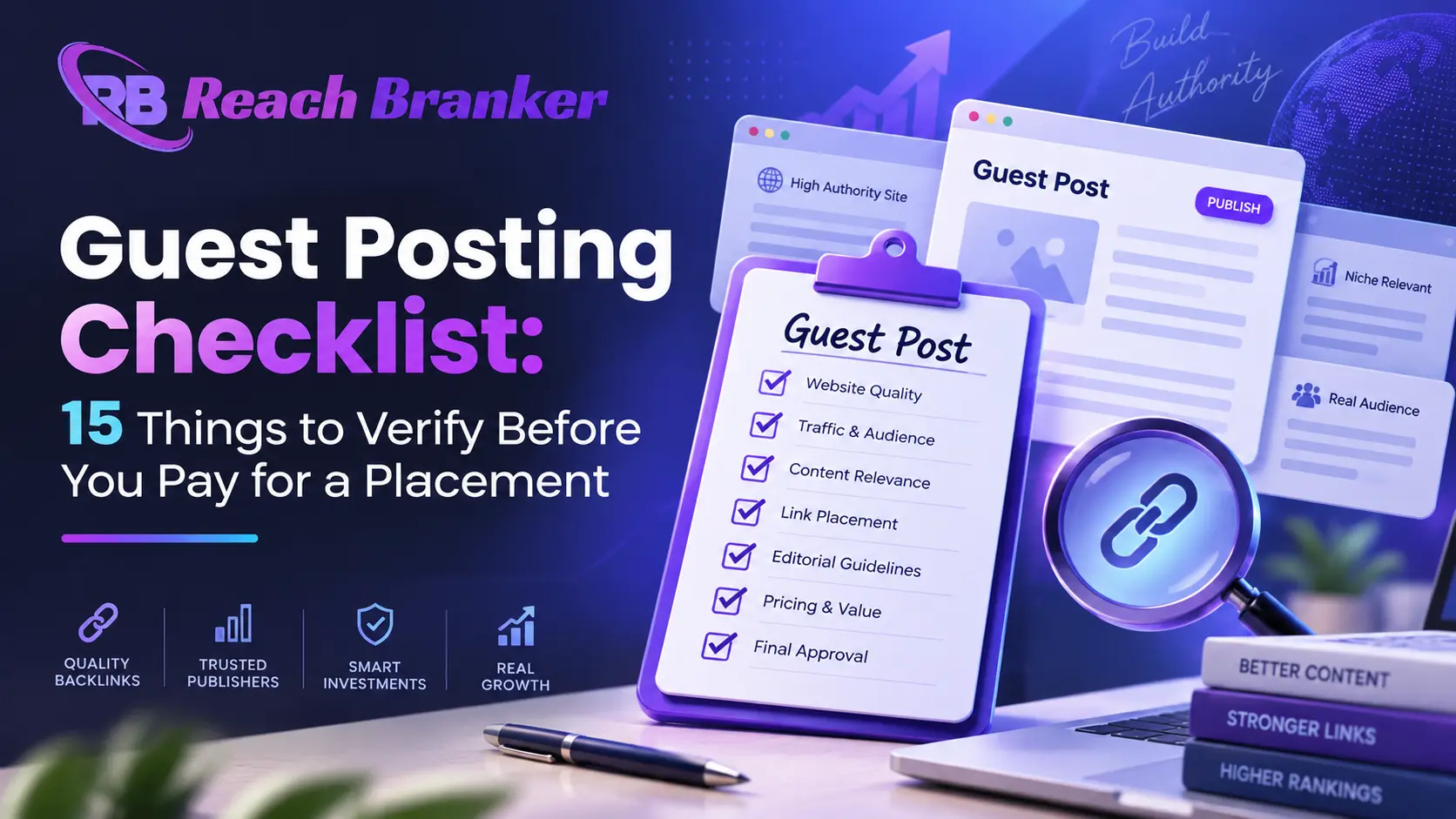
Before paying for any guest post in 2026, verify: real organic traffic (not just a Domain Authority score), topical relevance to your niche, genuine editorial review, a clean outbound link profile free of grey-niche links (casino, CBD, essay-writing, crypto), correct rel=”sponsored” or rel=”nofollow” disclosure on paid placements, in-body do-follow link placement, a written permanence guarantee, no history of domain flipping or expired-domain abuse, no active manual actions or spam signals, real audience engagement, and confirmation that the site does not mass-publish AI-generated guest content at scale. A placement that fails more than two or three of these checks is a liability, not an asset. Under Google’s site reputation abuse policy, a bad guest post can actively hurt the site that publishes it as much as the one that pays for it.
Key Takeaways
- Domain Authority alone tells you almost nothing. A DA 50 site with a flat or declining traffic graph is often worth less than a DA 25 site with steady, growing organic traffic.
- Google’s site reputation abuse policy (in force since March 2024, actively enforced through 2026) treats third-party content published mainly to exploit a host site’s ranking signals as spam (this affects the host site’s rankings, not just the guest poster’s link value).
- Undisclosed paid links are a policy violation on their own, separate from link quality. Any link acquired through payment must carry rel=”sponsored” or rel=”nofollow”.
- The October 2025 spam update specifically targeted AI-generated guest post farms: sites publishing large volumes of thin, machine-written guest content purely to sell backlinks. Verifying editorial standards is no longer optional due diligence, it’s protection against buying into a site Google may deindex.
- Check whether the site’s previous guest posts are actually indexed. A surprising number of “guest post marketplaces” publish content that Google never indexes at all, meaning the link carries zero ranking value regardless of the site’s metrics.
- Grey-niche link neighborhoods matter more than most buyers realize. If a site links out to casino, loan, CBD, or essay-writing services alongside your placement, Google’s algorithms can classify the site as a link farm, dragging your link’s value down with it.
- A refund or replacement policy is a legitimate quality signal. Providers confident in their inventory offer clear terms for removed, deindexed, or non-live placements; those that don’t are usually hiding something.
Why This Checklist Matters More in 2026
Guest posting hasn’t become against the rules, but the cost of getting it wrong has gone up significantly. Between the ongoing enforcement of Google’s site reputation abuse policy, the October 2025 spam update targeting AI-generated guest post farms, and continued SpamBrain refinement through the June and August 2026 spam updates, the margin for buying a placement on a low-quality or manipulative site has essentially disappeared.
The practical risk isn’t just “the link won’t help.” It’s that a bad placement can actively signal manipulative intent to Google’s automated systems, and a pattern of links from low-quality, irrelevant, or clearly artificial sources can flag your entire backlink profile for review. This checklist exists because vetting a site properly, before money changes hands, is now the difference between a link that compounds in value over years and a liability sitting in your backlink profile.
The Complete 15-Point Guest Posting Checklist
1. Real Organic Traffic Trend: Not Just a DA/DR Score
Pull up the site’s organic traffic graph in Ahrefs, Semrush, or a similar tool, covering at least the last 12 months. You’re looking for stability or steady growth. A sharp cliff-drop usually means the site was hit by a core update or manual action and is actively losing search visibility, and a link from a declining site carries declining value along with it. Domain Authority and Domain Rating are proxies for link equity, not traffic; a site can have an inflated DA from old, unrelated backlinks while receiving almost no real search traffic today.
2. Topical and Niche Relevance
The site should sit clearly within, or closely adjacent to, your own topical area. Under Google’s site reputation abuse policy, a backlink from a wildly unrelated niche (a finance site linking out through a “lifestyle” guest post section, for example) reads as a sign that the content exists to exploit the host’s authority rather than serve its actual readers. Relevance isn’t just about ranking value, it materially affects whether the placement is safe at all.
3. Genuine Editorial Review
Ask directly: does an editor read and approve the draft before publishing, or does the site publish whatever is submitted? Sites with real editorial standards will request revisions, reject off-topic pitches, and maintain a consistent voice across their content. A site that publishes anything submitted, with no gatekeeping, is functionally a link marketplace regardless of how it’s marketed, and it is exactly this pattern that recent spam updates have targeted.
4. Outbound Link Neighborhood
Review the last 10–15 published articles on the site and check where their outbound links point. Look specifically for grey and black-hat niches: online betting/casino, CBD, essay-writing services, payday loans, crypto schemes, and pharmaceutical products without proper credentials. If a general business or tech blog is linking out to casino sites, Google’s systems are likely to have already classified it, or will soon classify it, as a link farm, and any link you place there inherits that classification risk.
5. Paid Link Disclosure Compliance
This is the single most overlooked item on most guest posting checklists. Google’s guidelines are explicit: any link acquired through payment, product exchange, or other commercial arrangement must carry rel=”sponsored” or, at minimum, rel=”nofollow”. A do-follow link presented as pure editorial content, when money changed hands, is a policy violation independent of the link’s quality or relevance. Ask the publisher directly how they handle link attributes on paid content, and get the answer in writing before you pay.
6. Link Placement Within the Content
An in-body, contextual link, placed naturally within an explanatory paragraph, carries meaningfully more signal than a link buried in an author bio, sidebar, or footer. Confirm exactly where your link will sit before payment, not after the article is live. Providers sometimes advertise “guest post” pricing but deliver bio-only or footer placements, which perform very differently.
7. Permanence Guarantee
Ask explicitly: does the link stay live indefinitely, or does the site remove or paywall links after a set period? Some lower-quality providers quietly remove links after a few months, or demand a recurring “renewal fee” to keep them live, effectively renting rather than selling a placement. Get the permanence terms in writing before payment.
8. Domain History (Expired Domain Abuse Check)
Run the domain through the Wayback Machine. If the site’s topic, branding, or content focus has changed dramatically at some point in its history, particularly if it was repurposed from an expired domain with unrelated prior content, treat this as a serious red flag. Google’s spam policies explicitly define expired domain abuse: buying a domain for its accumulated authority and repurposing it with unrelated content to pass link equity elsewhere is a named violation, not a grey area.
9. Manual Actions and Spam Signals
If you have any way to check (via a trusted contact, a shared Search Console view, or third-party spam-score tools), look for signs of manual actions or elevated spam scores. A site currently under scrutiny, or with a history of penalties, is a poor place to place a new link regardless of its current metrics, since those metrics can evaporate overnight.
10. Real Audience Engagement
Vanity metrics like DA can mask a site with no actual readership. Look for comments, social shares, and evidence that content is genuinely read and discussed, not just indexed. A site with respectable authority metrics but zero real engagement often indicates a link-focused operation rather than an active publication with a genuine audience.
11. Site Design, UX, and Mobile Experience
A professional publication invests in its reader experience. Excessive ads, intrusive pop-ups, broken navigation, or a non-mobile-friendly layout are signs of a site optimized for ad revenue and link sales rather than reader value, exactly the pattern Google’s helpful content and site reputation systems are designed to catch.
12. Real Authors and an Active Editorial Team
Check the site’s “About” page and author bylines. Are there multiple real writers with visible bios, social profiles, and a consistent publishing history? A site with a single generic “Admin” author across hundreds of guest posts, with no editorial team visible, is typically a placement marketplace rather than an independent publication with its own voice.
13. Guest Post Publishing Volume and Pattern
Check how frequently the site publishes guest content, and whether nearly every recent post reads as an obvious guest contribution (generic tone, formulaic structure, no site-specific voice). Sites publishing multiple guest posts daily, month after month, with no apparent limit, are the clearest signal of a pay-for-play operation, precisely the large-scale, low-editorial-standard pattern the October 2025 spam update targeted.
14. Anchor Text Control and Naturalness
Confirm what anchor text will be used and insist on branded, natural, or descriptive anchors over exact-match keyword anchors. Google’s link spam policies specifically flag “links with optimized anchor text in articles, guest posts, or press releases” as a named violation pattern. A publisher who pushes back on unnatural, keyword-stuffed anchor requests is, ironically, a better sign of legitimacy than one who accepts anything you ask for.
15. Indexation of Previous Guest Content
Before paying, spot-check 3–5 of the site’s previously published guest posts using a site: search or an indexing checker. If a meaningful share of the site’s own guest content isn’t indexed by Google at all, your placement is likely to face the same fate, meaning you’re paying for a link that search engines never actually process, regardless of how good the site’s on-paper metrics look.
Read More: Blogger Outreach, A Complete Guide for 2026
Checklist at a Glance
| # | Check | Pass Signal | Fail Signal |
|---|---|---|---|
| 1 | Organic traffic trend | Stable or growing (12 months) | Sharp, unexplained decline |
| 2 | Niche relevance | Clearly within or adjacent to your topic | Unrelated niche, “general” catch-all site |
| 3 | Editorial review | Edits requested, some pitches rejected | Publishes anything submitted |
| 4 | Outbound link neighborhood | Links to relevant, reputable sources | Links to casino/CBD/loans/crypto |
| 5 | Paid link disclosure | rel=”sponsored” or rel=”nofollow” offered | Do-follow only, no disclosure discussion |
| 6 | Link placement | In-body, contextual | Bio-only, sidebar, or footer |
| 7 | Permanence | Written permanence guarantee | Vague or “renewal fee” language |
| 8 | Domain history | Consistent niche over time | Repurposed expired domain |
| 9 | Manual actions/spam | No visible penalty history | Known manual action or spam flags |
| 10 | Audience engagement | Comments, shares, real interaction | High metrics, zero engagement |
| 11 | Site UX/design | Clean, professional, mobile-friendly | Ad-heavy, broken, poor mobile UX |
| 12 | Real authors | Multiple bylines, visible bios | Single generic “Admin” author |
| 13 | Guest post volume | Occasional, selective publishing | Multiple guest posts daily |
| 14 | Anchor text | Branded/natural anchors | Exact-match keyword anchors pushed |
| 15 | Indexation of past posts | Prior guest posts indexed | Prior guest posts not indexed |
Red Flags That Should End Negotiations Immediately
Some signals are severe enough that no amount of otherwise-good metrics should override them:
- The site is listed on a third-party “marketplace” advertising guest post slots for sale. Legitimate publications rarely list placements in link marketplaces with fixed price lists.
- “Write for us” is prominently and aggressively advertised sitewide, especially combined with instant acceptance.
- The provider guarantees a specific ranking outcome. No legitimate guest post seller can guarantee where your target page will rank.
- The site refuses to disclose where your link will physically appear before payment.
- Bulk package pricing that looks too good to be true (“50 guest posts for $99”). This pricing structure is only sustainable on link farms.
How to Actually Run These Checks (Tools and Steps)
- Traffic and history: Ahrefs or Semrush (Organic Traffic report, 12-month view) plus the Wayback Machine for domain history.
- Spam and manual action signals: Third-party spam-score tools, or a shared Search Console view if the publisher will provide one.
- Outbound link neighborhood: Ahrefs’ “Outgoing Links” report or a manual review of the last 10–15 published articles.
- Indexation check: A
site:domain.com "exact guest post title"search, or a bulk indexing checker tool, run against 3–5 previous guest posts. - Editorial standards: A direct email exchange, asking about revision process, editorial guidelines, and rel attribute policy, and evaluating the professionalism of the response itself.
Free vs. Paid Guest Posts: What Changes in the Checklist
| Factor | Free (Earned) Guest Post | Paid Guest Post |
|---|---|---|
| Rel attribute requirement | Not required (genuinely editorial) | rel=”sponsored” or rel=”nofollow” required |
| Editorial scrutiny | Usually higher, earned on merit | Varies widely; must be verified directly |
| Negotiating power on link placement | Limited, site sets terms | You can and should negotiate placement, permanence |
| Risk profile | Generally lower | Higher, requires full 15-point verification |
| Time investment | High (pitching, relationship building) | Lower, but higher due-diligence cost per placement |
What Google’s Guidelines Actually Say
Google’s link spam policies define a link scheme as any practice intended to manipulate a site’s ranking through link acquisition, explicitly including buying or selling links that pass ranking credit and large-scale guest posting or article campaigns undertaken primarily for link acquisition rather than audience value. Separately, the site reputation abuse policy, enforced since March 2024 and actively reinforced through subsequent 2026 spam updates, targets third-party content published on an established site mainly to exploit that site’s existing ranking signals, rather than to serve its genuine readership. Google’s guidance is consistent on the underlying test: would this content and this link exist if it didn’t help someone’s rankings? If the honest answer is no, the placement is a risk regardless of how strong the site’s surface-level metrics appear.
Read More: Site Migration SEO Checklist, How to Avoid Losing Rankings
Common Mistakes Buyers Make
- Judging a site by DA/DR alone, without ever checking the organic traffic graph.
- Never asking about rel=”sponsored” or rel=”nofollow” before paying, leaving an undisclosed paid link as a standing policy violation.
- Skipping the outbound link neighborhood check, missing that the site links out to grey or black-hat niches.
- Accepting bio-only or footer placement when believing they purchased an in-body contextual link.
- Not verifying whether previous guest posts are even indexed, paying full price for a link Google may never process.
- Treating bulk, deeply discounted packages as a bargain rather than a red flag for link-farm-style operations.
- Skipping the domain history check, missing that a site was recently an expired domain repurposed from an unrelated niche.
Frequently Asked Questions
Is guest posting still allowed by Google in 2026? +
Yes. Guest posting itself is not against Google’s guidelines. Problems arise when paid links are improperly qualified, editorial standards are weak, or placements are created primarily to manipulate search rankings.
What is the single most important item on this checklist? +
Real organic traffic combined with strong topical relevance. Authority metrics alone mean little if the website has declining traffic or no genuine relevance to your niche.
Do I really need rel=”sponsored” on a paid guest post link? +
Yes. Google recommends qualifying paid links with rel=”sponsored”, while rel=”nofollow” remains acceptable. Paid links should not be left as ordinary followed links intended to influence rankings.
How do I check if a site’s previous guest posts are actually indexed? +
Check several previously published guest posts individually in Google. If many of the site’s existing guest posts are consistently absent from the index, investigate the site’s indexing and content-quality issues before buying a placement.
What’s a reasonable price range for a legitimate guest post? +
There is no universal price. Costs vary by traffic, authority, niche, editorial quality, and publication, so evaluate the website itself rather than using price alone as a quality signal.
Should I avoid all sites that charge for guest posts? +
No. A paid placement is not automatically low quality. Evaluate editorial standards, topical relevance, real traffic, content quality, and proper disclosure before choosing a publisher.