
Quick Answer
A website migration, a domain change, a platform switch, a significant redesign, or a URL structure overhaul, carries genuine risk of losing existing rankings if not planned with SEO specifically in mind from the start. The core requirements for a safe migration include a complete crawl and inventory of the existing site before any changes happen, a full redirect map ensuring every old URL points to its correct new equivalent, and a structured post launch verification process checking crawling, indexing, and ranking recovery rather than assuming everything transferred correctly once the new site goes live.
Key Takeaways
Migration planning should begin with a complete crawl and inventory of the existing site, capturing every indexed URL before any changes happen, not after. Every old URL needs a specific, individual redirect to its correct new equivalent, a generic redirect to the homepage for pages with no clear match loses considerably more ranking value than a properly mapped one. Post launch verification should happen systematically, checking redirect functionality, crawl and indexation status, and ranking recovery over a defined monitoring period, not assumed to have gone smoothly without direct confirmation. Some ranking fluctuation during a migration is normal and expected, a genuine cause for concern is a decline that does not begin recovering within a reasonable, monitored timeframe. Treating migration as primarily a design or development project, without dedicated SEO involvement throughout planning and execution, is the single most common cause of significant, avoidable ranking loss.
Why Migrations Carry Real SEO Risk
Any significant change to a website’s URLs, domain, or structure genuinely risks disrupting the accumulated ranking signals search engines have built up over time for the existing site. This risk exists regardless of whether the migration involves moving to an entirely new domain, switching content management platforms, or simply restructuring URLs during a redesign, since all three changes affect the specific addresses search engines have indexed and associated with your existing rankings.
This does not mean migrations should be avoided, genuine business needs, a rebrand, a platform limitation, a necessary technical overhaul, often make migration the right decision despite the risk involved. It means migration specifically requires dedicated SEO planning throughout the process, not treated as a purely design or development concern with SEO considered only after launch.
Read More: Blogger Outreach, A Complete Guide for 2026
Before You Migrate, Complete Site Inventory
Before any changes begin, crawl your existing site completely and export a full inventory of every indexed URL, along with each page’s current ranking keywords, organic traffic, and existing backlink profile where available. This inventory becomes the essential reference point for everything that follows, without it, you have no reliable way to confirm every valuable existing page has a proper corresponding destination on the new site.
Pay particular attention to your highest traffic and highest converting pages specifically during this inventory process, these pages deserve the most careful individual attention during redirect mapping, given how much more significant losing their accumulated ranking value would be compared to a lower traffic page.
Read More: Link Building for Ecommerce Websites, A Practical 2026 Guide
Building a Proper Redirect Map
A redirect map is a complete, page by page record matching every old URL to its correct new equivalent, implemented using permanent, 301 status redirects specifically, which signal to search engines that the move is intentional and permanent, passing the vast majority of accumulated ranking value to the new destination.
Every single indexed URL from your site inventory needs an entry in this map, even pages that seem minor or low priority, since an unmapped URL either produces a broken error page or, worse, gets redirected generically to an unrelated page, both of which waste the ranking value that page had already accumulated.
Common Redirect Mistakes That Lose Ranking Value
Redirecting every old URL to the new homepage, rather than to its genuinely corresponding new page, is one of the most common and most costly migration mistakes. This blanket approach discards the specific relevance signal search engines had associated with each individual page, replacing dozens or hundreds of specific, relevant redirects with a single, generic one that provides considerably less value.
Redirect chains, where an old URL redirects to an intermediate URL that then redirects again to the final destination, also dilute ranking value and slow page load time. Every redirect in your map should point directly to its final destination in a single step, not through an intermediate hop that could and should be eliminated during the mapping process itself.
Updating Internal Links and Your XML Sitemap
Once redirects are in place, update your internal linking throughout the new site to point directly to the new URLs rather than relying entirely on the redirect layer to handle every internal link indefinitely. Relying purely on redirects for internal navigation adds unnecessary technical overhead and slightly dilutes link equity compared to direct, updated internal links.
Generate and submit a fresh XML sitemap reflecting your new site’s actual URL structure, and submit it directly through Google Search Console once the new site is live, giving search engines a clear, authoritative reference for what should now be crawled and indexed going forward.
What to Check Immediately After Launch
In the first days following launch, manually spot check a meaningful sample of your redirect map, confirming redirects actually function correctly and land on the intended destination page, not just that they exist in your configuration. Automated testing tools can check this at scale, but manual verification of your highest priority pages specifically remains worthwhile given how much value an error on these specific pages would represent.
Confirm your new site is properly accessible to search engine crawlers, checking robots dot txt has not accidentally blocked crawling entirely, a surprisingly common, easily avoidable migration mistake that can cause a far more serious drop than any redirect issue alone would produce.
Monitoring Recovery Over the Following Weeks
Some ranking fluctuation during and immediately after a migration is normal and expected, search engines need time to recrawl and reprocess the new URL structure, and genuine, temporary volatility during this period should not immediately trigger alarm. The genuine signal worth investigating is a decline that does not begin showing recovery within a reasonable, actively monitored timeframe, generally several weeks for most sites, rather than any single day’s fluctuation in isolation.
Track rankings, organic traffic, and crawl statistics through Search Console consistently throughout this monitoring period, comparing against your pre migration baseline captured during the initial site inventory, giving you a clear, objective reference for whether recovery is genuinely progressing as expected.
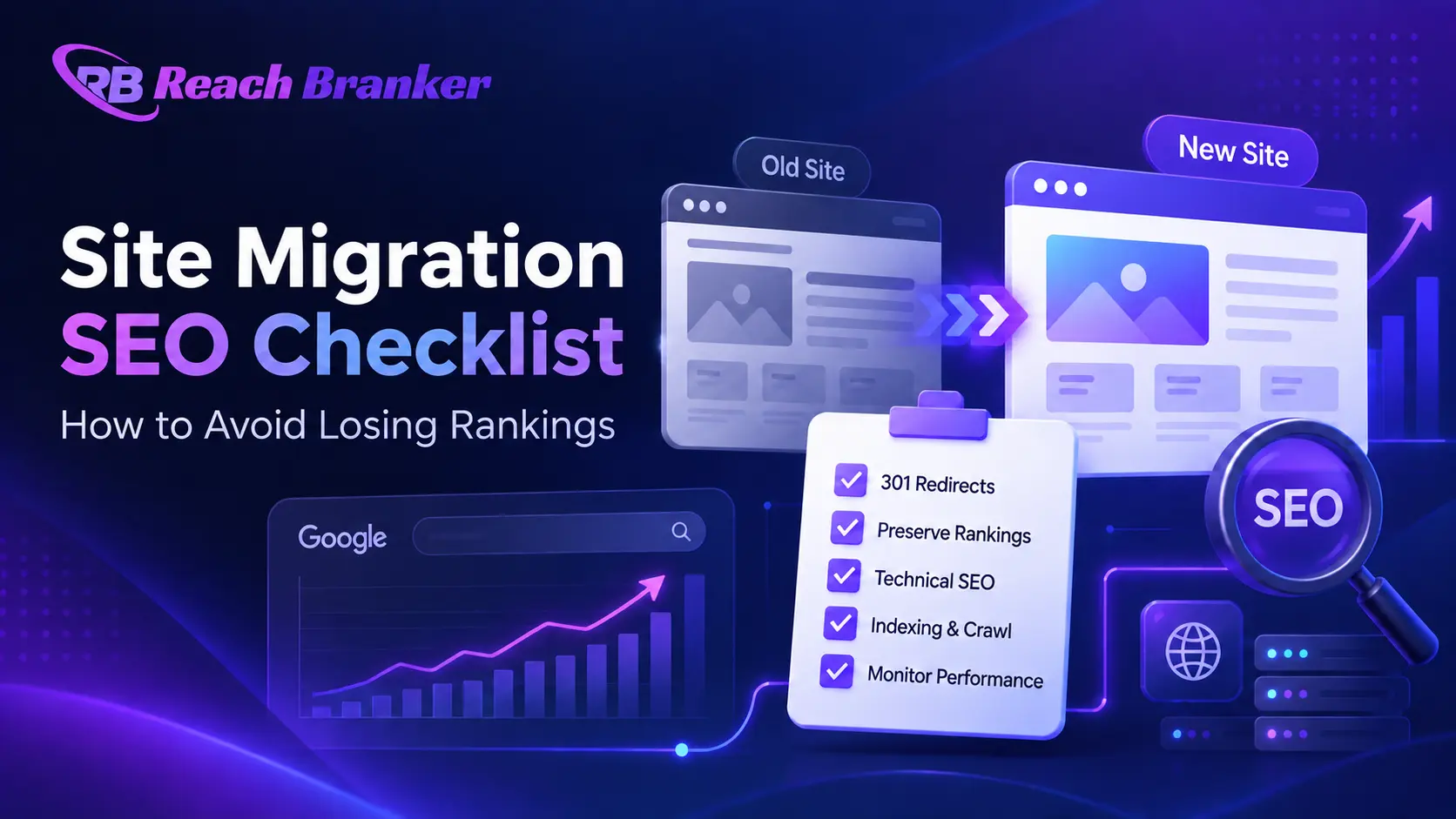
The ReachBranker Migration SEO Checklist
We apply a structured, four phase process to every migration we support.
- Pre migration inventory, crawling and documenting the complete existing site, prioritizing highest value pages for particular attention during redirect mapping.
- Redirect mapping and implementation, building a complete, page specific redirect map using 301 status redirects with no unnecessary chains or generic fallback redirects.
- Launch verification, manually and automatically confirming redirect functionality, crawlability, and correct indexation signals immediately following launch.
- Extended monitoring, tracking rankings, traffic, and crawl data against the pre migration baseline over a defined period, actively investigating any decline that does not show expected recovery within a reasonable timeframe.
Common Site Migration Mistakes
Treating migration as purely a design or development project, involving SEO only after launch rather than throughout the entire planning and execution process.
- Redirecting every old URL generically to the new homepage rather than mapping each one individually to its genuinely corresponding new page.
- Skipping a complete pre migration site inventory, leaving no reliable reference point for confirming every valuable existing page has a proper destination on the new site.
- Accidentally blocking search engine crawling on the new site through an incorrect robots dot txt configuration, a technical oversight capable of causing more serious damage than any individual redirect mistake.
- Assuming a migration went smoothly without systematic post launch verification, missing genuine issues that could have been caught and corrected quickly if actively monitored from launch day forward.
Expert Tips for a Genuinely Safe Migration
Begin SEO planning at the very start of any migration project, not as an afterthought once development work is already substantially complete. Prioritize your highest traffic and highest converting pages for the most careful individual attention throughout redirect mapping and post launch verification. Never use a redirect chain, every redirect should point directly to its final destination in a single step. Manually verify a meaningful sample of redirects immediately after launch, rather than relying solely on automated testing or assuming your configuration worked as intended. Monitor rankings and traffic against your documented pre migration baseline for at least several weeks following launch, treating a genuine, unexpected decline that fails to recover as a signal requiring direct investigation.
Conclusion
A genuinely safe site migration depends on treating SEO as a core planning consideration from the very start, not an afterthought addressed only once development is complete. Complete pre migration inventory, careful individual redirect mapping, and systematic post launch verification together protect the ranking value a site has accumulated over time, turning what could be a genuinely costly, avoidable setback into a smooth, well managed transition.
Frequently Asked Questions
How long does it take to recover rankings after a migration? +
It varies by site size and migration scope, but a well-executed migration can begin showing meaningful recovery within a few weeks. Some temporary ranking fluctuations are normal.
Should I redirect every old URL even if the new site has fewer total pages? +
Yes. Redirect each valuable old URL to its most relevant new equivalent. Avoid redirecting unrelated URLs to the homepage simply because an exact replacement does not exist.
What is the biggest single risk during a site migration? +
One of the biggest risks is accidentally blocking search engine crawling or indexing on the new site. Always verify robots.txt, robots directives, canonicals, and accessibility before launch.
Is some traffic loss during migration always expected? +
Some temporary fluctuation is common while search engines recrawl and process the new site. Continued or severe declines should be investigated rather than treated as normal migration behavior.