Quick Answer
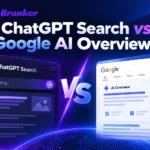
Google AI Overviews and ChatGPT Search are not competing for the same job. Google AI Overviews sit on top of Google’s existing search index and now appear on more than 25% of all Google searches, favoring pages that already rank well and reinforcing classic SEO fundamentals like crawlability, helpful content, and E-E-A-T. ChatGPT Search operates through its own crawler, OAI-SearchBot, and partner web data, skewing toward longer, research-heavy, multi-turn buyer questions rather than quick lookups. Independent analysis of 41 million results found ChatGPT’s citations overlap with the traditional Google results page by only about 12%, confirming these are genuinely separate visibility surfaces rather than two versions of the same list. For most businesses in 2026, the honest strategy isn’t choosing one over the other. It’s optimizing a single, well-structured page so it can win in both: reach through Google AI Overviews, and depth of buyer intent through ChatGPT.
Key Takeaways
- Google still dominates raw volume, handling roughly 8.5 billion searches a day, but AI Overviews now appear on more than 25% of those searches, up sharply from about 6.5% in January 2025.
- ChatGPT has grown to roughly 900 million weekly active users, up from 400 million in February 2025, making it the fourth most-visited website in the world with more than 5 billion monthly visits.
- ChatGPT’s citations overlap with Google’s organic results by only about 12%, and with Bing’s results by only 26%, despite ChatGPT’s web browsing being Bing-powered, meaning the two surfaces are genuinely showing different sources for the same queries.
- ChatGPT drives a comparatively small direct traffic share for most businesses, roughly 1 to 3%, but that referral category is growing more than 600% year over year off the same underlying web.
- B2B buying behavior has shifted meaningfully. G2’s 2026 research found 51% of B2B software buyers now start research with AI chatbots more often than Google, and 69% say AI guidance has influenced them to choose a different vendor than they originally considered.
- The two engines reward different structural signals. Google AI Overviews favors pages that already rank well organically, while ChatGPT Search specifically rewards pages that answer the question directly and early, use clear headings, and cite primary sources, penalizing long preambles in both cases.
- Google search volume per user has fallen roughly 20% year over year, not primarily because users are abandoning Google, but because AI-generated summaries let each user complete a task in fewer individual searches.
Why This Comparison Matters for Every Business in 2026
For most of the last two decades, “where does my business need to show up online” had a simple answer: Google. Rank well, get found, earn the click. That answer is no longer complete, even though it remains largely true. Google still processes an enormous volume of daily search traffic, but a genuinely new layer of AI-native search behavior has grown up alongside it, fast enough that treating it as a side experiment rather than core strategy is now a measurable business risk.
The mistake most businesses make when approaching this shift is framing it as a consumer choice question: which tool do people prefer, Google or ChatGPT? That’s the wrong frame for a business trying to stay visible. The more useful questions are what this fragmentation actually does to how buyers discover and evaluate options, why no single engine is capturing the majority of this new behavior, and what a business should concretely do differently as a result.
Read More: Content Velocity: How to Use Google Trends Breakout Topics to Win AI Search in 2026
The Core Mechanism Difference
The clearest way to understand the practical difference between these two surfaces is this: Google returns a ranked list of options and lets the user choose, while ChatGPT composes a single answer and effectively chooses on the user’s behalf. For a business, this reframes what visibility even means. Google visibility is fundamentally about position, earning one of a limited number of slots a user will scan and click through. AI visibility, whether inside an AI Overview or a ChatGPT response, is about being the name that actually appears inside the generated answer itself, regardless of whether the user ever clicks through to a website at all.
This distinction explains why classic ranking metrics alone no longer fully describe your visibility. A page can rank well and still be excluded from an AI Overview’s citation panel, and a page can be cited by ChatGPT without ranking prominently, or at all, in Google’s traditional results.
Market Share and Usage Data
Understanding where genuine attention currently sits, and how quickly that’s shifting, matters more than picking a side.
| Metric | Figure |
| Google daily searches | Approximately 8.5 billion |
| Google AI Overviews search coverage | 25%+ of all Google searches (up from ~6.5% in January 2025) |
| ChatGPT weekly active users | Approximately 900 million (up from 400 million in February 2025) |
| ChatGPT monthly visits | Over 5 billion (4th most-visited website globally) |
| ChatGPT monthly web visits (Similarweb, May 2026) | Approximately 5.57 billion |
| Gemini monthly web visits (Similarweb, May 2026) | Approximately 2.90 billion |
| Claude monthly web visits (Similarweb, May 2026) | Approximately 953 million |
| Perplexity monthly queries | Approximately 780 million, growing 370% year over year |
| Consumers starting searches with AI tools instead of Google | 37% |
| ChatGPT’s citation overlap with Google’s organic results | Only about 12% |
| Google search volume per US user, year over year | Down roughly 20% |
The pattern worth sitting with here isn’t that any single AI engine is overtaking Google in raw volume, none currently are. It’s that the AI-referral category as a whole is compounding fast off the same underlying web, and the overlap data confirms these engines are genuinely surfacing different sources for the same underlying questions, not simply re-displaying the same top-ranked pages through a different interface.
How Each Engine Actually Selects Sources
Google AI Overviews are generated directly on top of Google’s existing search index, which means classic SEO fundamentals remain squarely relevant: crawlability, genuinely helpful content, and clear E-E-A-T signals all still matter. Pages that already rank well organically for a given query are consistently the strongest candidates to be pulled into the Overview’s citation panel, making a strong existing organic foundation the single best starting point for AI Overview visibility specifically.
ChatGPT Search works differently at the infrastructure level. It uses OpenAI’s own crawler, OAI-SearchBot, combined with web results sourced through partner providers, rather than relying on Google’s index. Despite this different retrieval mechanism, the content-level preferences converge in an important way: ChatGPT specifically rewards pages that answer the actual question directly and early, use clear, scannable headings, and cite primary sources rather than secondary summaries. Long, scene-setting preambles measurably hurt performance in both systems, and thin, keyword-stuffed content loses in both places as well.
The practical implication is that these are complementary rather than identical optimization targets. A page engineered purely to satisfy traditional ranking signals may miss ChatGPT’s stronger preference for immediate, well-sourced answers, while a page written only in a conversational, answer-first style without underlying organic authority may struggle to enter Google’s AI Overview candidate pool in the first place.
Read More: How Google AI Overviews Choose Sources (And How to Get Cited)
Where Each Engine Wins in the Buyer Journey
Google AI Overviews wins on sheer reach. Embedded inside the world’s dominant search engine, it touches billions of queries daily and remains the default entry point for the broadest range of search intents, from simple factual lookups to early-stage category discovery.
ChatGPT wins on depth of engagement for a narrower, higher-intent slice of that behavior. Its users tend to ask longer, more research-heavy questions and follow up conversationally within the same session, a pattern that favors thorough, well-sourced content over quick, surface-level answers. ChatGPT skews particularly toward the research and evaluation stage of a purchase decision, the point at which a buyer is actively forming and narrowing a consideration set rather than just discovering that a category exists.
Crucially, the same buyer very often uses both surfaces within a single decision cycle: discovering a category or need through Google, then shifting to ChatGPT or a similar conversational tool to compare specific vendors in depth, before potentially returning to Google or visiting a brand’s site directly to complete the decision. This is precisely why treating the two as mutually exclusive channels, rather than sequential touchpoints in the same journey, undersells the strategic importance of showing up well in both.
The B2B Shift Is Bigger Than Most Businesses Realize
The buyer journey shift described above is not a marginal trend in B2B software specifically, it’s already a majority behavior. G2’s 2026 research found that 51% of B2B software buyers now start their research with AI chatbots more often than with Google, a genuine majority-behavior tipping point rather than an early-adopter niche. More strikingly, 69% of those buyers reported that AI-generated guidance actively influenced them to choose a different vendor than the one they originally had in mind.
For B2B businesses specifically, this means being visible on Google while remaining invisible or poorly represented inside ChatGPT and similar tools risks losing buyers at the exact consideration stage where vendor shortlists are actively being formed and narrowed, well before those buyers ever reach a branded search or a direct website visit where traditional analytics would normally capture the interaction.
The Shared Foundation: What Optimizes for Both
Despite their different retrieval mechanisms, Google AI Overviews and ChatGPT Search share a meaningfully overlapping set of content fundamentals, which is genuinely good news for any business trying to build a single, coherent strategy rather than maintaining two entirely separate content programs.
- Direct, early answers. Both systems consistently favor content that states a clear, complete answer near the top of the page, followed by supporting evidence and detail, over content that builds up to its conclusion through a long introduction.
- Clean, scannable structure. Clear heading hierarchy and well-organized sections help both systems parse and extract content accurately, regardless of which underlying retrieval mechanism is doing the parsing.
- Primary-source citation and original evidence. Both systems increasingly favor content that cites primary sources and includes genuinely original evidence, data, or analysis over content that simply restates existing secondary coverage.
- Strong entity signals. Clear, consistent brand and author identity, reinforced through structured data and consistent presence across the web, helps both Google’s Knowledge Graph-driven systems and ChatGPT’s own entity reasoning correctly recognize and trust your brand.
- Technical SEO and crawlability. Since ChatGPT’s web results still ultimately draw from a crawled index of the same underlying web that Google indexes, ensuring your site is fully crawlable and technically sound remains foundational to visibility in both systems, not just traditional Google rankings.
The practical takeaway: rather than building separate content tracks for “Google SEO” and “ChatGPT optimization,” the more efficient and durable approach is optimizing the underlying SEO foundation that every one of these engines ultimately retrieves from, then layering engine-specific refinements on top where genuinely warranted.
How to Track Performance Across Both Engines
Measuring visibility across both surfaces requires pulling from more than one reporting source, since neither platform’s native analytics captures the full picture on its own.
- For Google AI Overviews, Search Console remains the primary tool. While it doesn’t yet provide a fully isolated AI Overview citation report for every account, monitoring impression and click patterns for queries known to trigger AI Overviews, alongside any available citation-specific reporting your rank-tracking platform offers, gives a workable proxy for performance.
- For ChatGPT, track referral traffic through your GA4 referrer reports specifically, since ChatGPT-driven visits arrive as a distinct, identifiable traffic source separate from organic search. Given that ChatGPT’s direct traffic contribution is typically modest, in the range of 1 to 3% for a typical business, treat this less as a primary KPI and more as a leading indicator of growing AI-driven consideration-stage influence that traditional analytics only partially captures.
- Across both, periodically running your own target buyer questions directly through each platform, and recording whether and how your brand is mentioned, remains the most direct, if manual, way to validate whether your optimization work is translating into actual AI visibility, beyond what either platform’s own reporting surfaces.
Common Mistakes When Choosing Where to Focus
- Treating this as a binary choice. Businesses that pick one engine to optimize for exclusively miss the reality that most buyers move between both within a single decision cycle.
- Ignoring ChatGPT because its direct traffic share looks small. A 1 to 3% direct traffic contribution understates its actual influence on buyer decisions, particularly in B2B contexts where AI-guided consideration shapes shortlists before a click ever occurs.
- Assuming strong Google rankings automatically translate to ChatGPT visibility. Given the roughly 12% citation overlap between the two systems, this assumption leaves a genuinely separate, sizable visibility surface unaddressed.
- Neglecting crawlability for non-Google bots. Since ChatGPT and other AI systems rely on their own crawlers and partner data, technical blocks or poor crawlability that don’t affect Googlebot specifically can still exclude a site from these other surfaces entirely.
- Writing separate, disconnected content for each engine. Given how much the underlying content fundamentals overlap, maintaining two entirely separate content strategies is usually inefficient compared with building one strong foundation and refining it for engine-specific nuances.
Conclusion
The ChatGPT versus Google AI Overviews question is ultimately a distraction from the more useful one: how do you build visibility across a search landscape that has genuinely fragmented, without abandoning the fundamentals that still anchor all of it. Google remains the larger surface by an order of magnitude and continues to reward the classic pillars of crawlability, helpful content, and E-E-A-T through its AI Overviews. ChatGPT and its peers represent a smaller but rapidly compounding, higher-intent research layer, one with real, measurable influence over buying decisions, particularly in B2B, that traditional analytics can easily understate.
The businesses that navigate this well in 2026 aren’t the ones picking a side. They’re the ones building a single, well-structured content foundation, direct answers, clean structure, genuine primary-source evidence, and strong entity signals, that every one of these engines can retrieve from, then tracking performance across both surfaces deliberately rather than assuming success in one implies success in the other. As the AI-referral share of the search landscape keeps compounding, that foundation is what will keep paying off regardless of which specific engine happens to be growing fastest in any given quarter.
FAQs
Is ChatGPT actually replacing Google search? +
No. Google still handles far more searches overall. ChatGPT and similar AI tools are becoming a complementary search layer, particularly for research-heavy and multi-turn queries.
Why does my ChatGPT referral traffic look so small compared to organic search? +
ChatGPT referral traffic may represent only a small share of direct visits, while its broader influence can occur earlier in the research process by shaping brand awareness, comparisons, and vendor shortlists.
Do I need separate SEO strategies for Google AI Overviews and ChatGPT Search? +
Not entirely. Both benefit from clear answers, strong content structure, trustworthy sources, and clear entity signals. Build one strong SEO and GEO foundation, then add platform-specific refinements.
Why is the citation overlap between ChatGPT and Google so low? +
ChatGPT and Google use different retrieval and source-selection systems. As a result, they can choose different sources even when answering similar questions.
How should I track whether my content is performing well across both engines? +
Use Google Search Console and GA4 alongside regular testing of important buyer queries across Google and ChatGPT. Track brand mentions, citations, referral traffic, visibility, and conversions over time.
Is this shift more important for B2B or B2C businesses? +
Both are affected, but AI search can be especially important for B2B because buyers often use AI tools for research, comparisons, evaluation, and vendor selection before contacting a company.