
Quick Answer
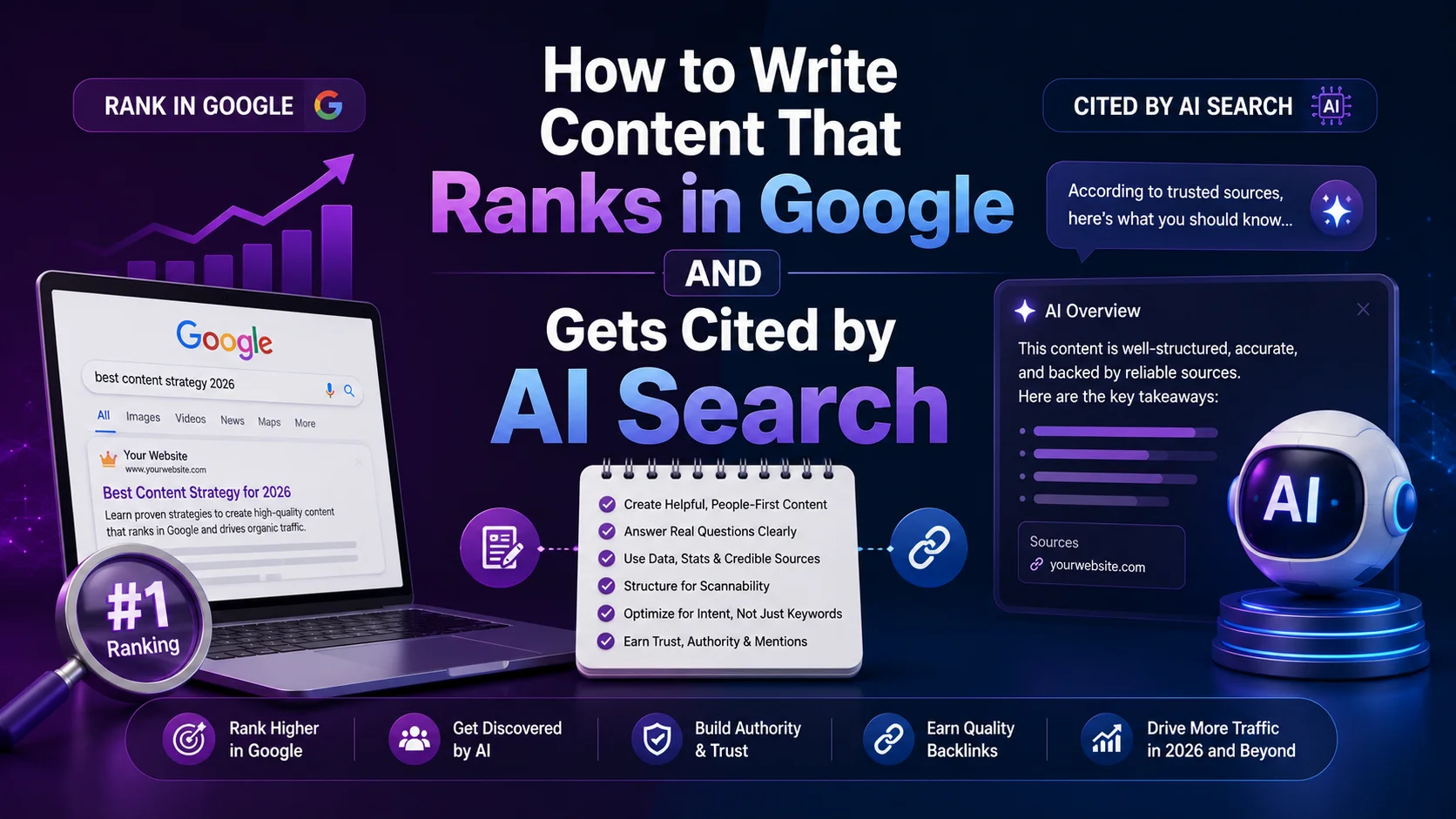
Content that ranks well in Google and gets cited by AI search systems is, in almost every meaningful respect, the same content, written the same way. Both traditional search ranking and AI citation reward genuinely useful, clearly structured writing that leads with a direct answer, names specific entities instead of vague references, supports claims with verifiable detail, and covers a topic with real depth rather than surface-level generality. There is no separate secret formula required for AI visibility that somehow conflicts with strong traditional SEO writing. The overlap is close to complete, and treating them as two different disciplines usually just produces worse content for both.
Key Takeaways
The same structural qualities that earn featured snippets and strong rankings also make content easier for AI systems to extract and cite. Entity clarity, naming specific people, products, and concepts rather than using vague pronouns, matters for both traditional relevance signals and AI retrieval accuracy. Genuine information gain, saying something a competing page has not already said, remains the single strongest lever for both ranking and citation. Artificially fragmenting content into unnatural short chunks to game AI extraction tends to hurt readability without meaningfully improving actual citation performance. A single well-built page can realistically satisfy featured snippets, voice search, AI citation, and traditional ranking simultaneously, without requiring separate versions for each.
Why This Is Not Actually Two Separate Skills
A great deal of current content advice treats writing for traditional search rankings and writing for AI search citation as two distinct disciplines requiring separate techniques, sometimes even separate versions of the same content. This framing creates unnecessary complexity and often leads to worse outcomes on both fronts, because writers end up either ignoring genuine AI readability improvements out of fear of hurting traditional SEO, or over engineering content into an artificially fragmented, robotic format that reads poorly for humans while providing little actual citation benefit.
The genuine underlying reality is simpler. Both systems are, at their core, trying to identify content that clearly, accurately, and completely answers what a real person is looking for. A page built around that single goal, executed well, tends to satisfy both systems at once, because both systems were designed around the same fundamental purpose even though their retrieval mechanics differ.
The Shared Foundation Behind Both Systems
Traditional search ranking evaluates a page against hundreds of signals accumulated over time, including relevance, authority, technical performance, and user satisfaction indicators. AI search retrieval evaluates specific passages of content in the moment against a particular query, weighing clarity, completeness, and apparent trustworthiness. These are different mechanisms, but they are pointed at largely the same underlying qualities.
A page that genuinely, thoroughly answers a real question, written clearly enough that a reader does not need to search elsewhere for a fuller answer, tends to perform well under both evaluation systems. A page that vaguely gestures at a topic without committing to specific, checkable claims tends to perform poorly under both as well. This shared foundation is why a single writing method, done well, covers both goals rather than requiring separate approaches.
Writing the Opening Section So It Works for Both
The opening of any piece of content carries disproportionate weight for both traditional search snippets and AI extraction, and the same technique serves both purposes.
- State the direct answer in the first one to three sentences, before any scene setting, historical context, or gradual buildup. A reader scanning quickly, and an AI system evaluating whether this passage answers the query, both benefit from the same immediate clarity.
- Follow the direct answer with a brief expansion that adds necessary nuance without diluting the initial clarity. This second layer gives both a human reader and a retrieval system additional confidence in the completeness of the answer.
- Avoid opening with a question the piece is about to answer, framed as a hook. This common writing convention, while sometimes effective for pure engagement, actively works against both traditional snippet extraction and AI citation, since it delays the actual information the reader or system is looking for.
Structuring the Body for Depth and Extractability
Beyond the opening, the overall structure of a piece should organize information so each section stands reasonably well on its own while still contributing to the whole.
- Use one heading per genuinely distinct question or subtopic, rather than grouping several loosely related points under a single vague heading. A heading titled specifically around one real question extracts far more cleanly than a broad, ambiguous label.
- Place comparative or sequential information into genuine tables and lists rather than describing it purely through flowing prose. Both traditional snippet systems and AI retrieval parse structured formats more reliably than the equivalent information embedded in paragraph form.
- Maintain genuine depth within each section rather than only providing a surface level summary. A section that fully answers its specific question, including relevant detail and nuance, performs better for both systems than one that gestures at an answer without actually completing it.
- Resist the temptation to artificially chop content into unnaturally short, disconnected sentences purely in an attempt to appear more machine readable. Genuine clarity and natural readability already produce the structure both systems respond well to, without needing to sacrifice how the content actually reads for a human audience.
Naming Entities Clearly Throughout
One of the most consistently underused techniques across otherwise well written content is explicit entity naming, and it matters equally for traditional relevance signals and AI citation accuracy.
Instead of writing our service, our process, or this approach repeatedly, name the specific service, product, method, or organization directly, particularly in any passage meant to stand as a clear, citable claim. Instead of writing it improved results significantly, write something specific and checkable, such as the guest posting campaign increased referring domains by a stated amount over a stated period.
This specificity does two things simultaneously. It gives traditional search systems clearer relevance signals connecting your content to the exact entities and concepts it discusses, and it gives AI systems something concrete and attributable to actually extract and cite, rather than a vague claim with no clear subject a system could confidently reference.
Supporting Claims With Verifiable Specifics
Both ranking systems and AI citation systems appear to weigh specificity and verifiability favorably, and for good reason. A vague claim such as many businesses find this helpful provides essentially nothing a system can evaluate or trust. A specific claim such as a majority of surveyed SEO professionals report this tactic as effective, tied to identifiable research, gives both a human reader and an evaluating system something concrete to assess.
This does not mean every sentence needs a citation or statistic attached. It means favoring genuinely specific, checkable language over vague, unfalsifiable phrasing wherever the underlying claim actually supports that specificity, and being honest about genuine uncertainty rather than dressing up a vague claim in confident sounding language it has not earned.
Where AI Optimized Writing Genuinely Differs From Traditional SEO Writing
The overlap between these two goals is close to complete, but a few genuine, worthwhile distinctions exist. AI systems appear to weigh consistency of terminology across an entire site somewhat more heavily than traditional ranking does for any single page, since AI retrieval sometimes draws on patterns across multiple pages from the same source when evaluating overall trustworthiness on a topic. Using consistent terminology for your key concepts across your whole site, rather than varying phrasing purely for stylistic variety, supports this consistency signal.
AI citation appears somewhat less dependent on traditional authority signals such as backlink volume than conventional ranking is, meaning a well structured, genuinely useful page from a newer or smaller site has a realistic chance at AI citation even without the accumulated authority that traditional ranking for competitive terms typically requires.
Traditional ranking rewards content that keeps a reader engaged and reduces the likelihood of returning to search results, while AI citation is somewhat more narrowly focused on whether a specific passage answers a specific query completely and accurately, independent of broader engagement metrics that do not directly apply within an AI conversation.
A Practical Writing Checklist
Before publishing any piece intended to perform well across both systems, check the following. Does the opening of each major section state a direct, complete answer within the first few sentences. Does every heading correspond to exactly one real, specific question rather than a vague topic label. Are specific entities named explicitly in key passages rather than relying on vague pronouns?
Are claims specific and checkable rather than vague and unfalsifiable wherever the underlying information supports that specificity. Does the piece say something genuinely new relative to existing top-ranking content on the same topic, rather than simply restating widely available information? Is comparative or sequential information presented in genuine tables and lists rather than only in prose? Would the piece read naturally and clearly to a genuine human reader, independent of any AI or search optimization consideration entirely?
A piece that satisfies every item on this list is very likely to perform reasonably well across traditional rankings, featured snippets, and AI citation simultaneously, without requiring separate versions built for each individual system.
A Practical Example: Revising a Real Passage Against the Checklist
Consider a paragraph from an early content draft: There are several important things businesses should think about when choosing a link building partner, and it really comes down to what matters most for your specific situation and goals. Running this against the checklist immediately reveals several failures. There is no direct answer, only a vague setup. No entities are named. No claim is specific or checkable.
A revised version addressing each checklist item might read: Choosing a link-building partner should come down to three checkable factors, transparency about which specific publisher sites are involved before payment, a documented process for verifying traffic and relevance rather than relying on Domain Authority alone, and clear written terms covering anchor text and content ownership. This revised version states a direct answer immediately, names specific, concrete factors rather than vague considerations, and gives both a human reader and an AI system something genuinely useful and citable to work with.
This kind of line by line revision, run consistently against the checklist during editing rather than only during initial drafting, tends to produce the most reliable improvement across an existing content library.
Common Mistakes That Undermine Both Goals at Once
Burying the actual answer under an extended introduction, which hurts snippet extraction, AI citation, and genuine reader experience simultaneously. Writing vague, hedge heavy claims that avoid committing to anything specific enough to be genuinely useful or citable.
- Artificially fragmenting content into disconnected short sentences under the mistaken belief this specifically helps AI systems, when it primarily just produces worse reading experience without meaningful citation benefit.
- Restating widely available information without adding any genuine new insight, example, or depth relative to what is already easily found elsewhere on the same topic.
- Using inconsistent terminology for the same core concept across different pages on the same site, diluting the clarity of what the site is actually an authority on.
Expert Tips for Writing Once and Performing Everywhere
Write the direct answer to your piece’s core question before writing anything else, even if it later moves within the final structure, since this forces genuine clarity about what the piece is actually answering. Read your own opening paragraph and ask honestly whether it could be lifted whole and used as a complete, accurate answer somewhere else. If not, revise it before moving forward. Build genuine specificity into your writing process by asking, for any claim that feels vague, what specific detail would make this checkable and concrete. Maintain a consistent glossary of your key terms and concepts, and use those exact terms consistently across your site rather than varying phrasing purely for stylistic reasons. Treat information gain as a required step in your writing process, explicitly identifying what your piece says that existing top ranking content on the same topic does not already say clearly.
Conclusion
The idea that writing for Google and writing for AI search citation require fundamentally different skills does not hold up under real scrutiny. Both systems, despite genuinely different underlying mechanics, are ultimately evaluating the same core qualities, clarity, genuine usefulness, specificity, and depth. A writer who masters the discipline of leading with direct answers, naming entities clearly, supporting claims with real specifics, and consistently adding genuine information gain will find their content performing well across traditional rankings, featured snippets, and AI citation simultaneously, without ever needing to write two separate versions of the same piece.
Talk to Our Team About Content Built for Both Search and AI Visibility. Explore Our SEO Content Writing Services.
Frequently Asked Questions
No. A single well-structured piece can satisfy both. Clarity, specificity, genuine depth, and direct answers benefit both search engines and AI systems.
Clear and logical structure helps, but artificially shortening paragraphs can hurt readability without providing meaningful SEO benefits.
Information gain is highly important because original, useful information gives search engines and AI systems a stronger reason to prioritize your content.
No. Use natural language and pronouns normally. Explicit entity naming matters most in important answers, definitions, and key claims.
Yes. The same principles apply, while technical topics often benefit from clear definitions and specific, verifiable details.
No fixed length is required. Focus on providing enough depth to answer the topic completely rather than targeting a specific word count.
Use your content checklist to identify issues such as buried answers, vague claims, and weak specificity. These are strong signs that revision is needed.