Quick Answer
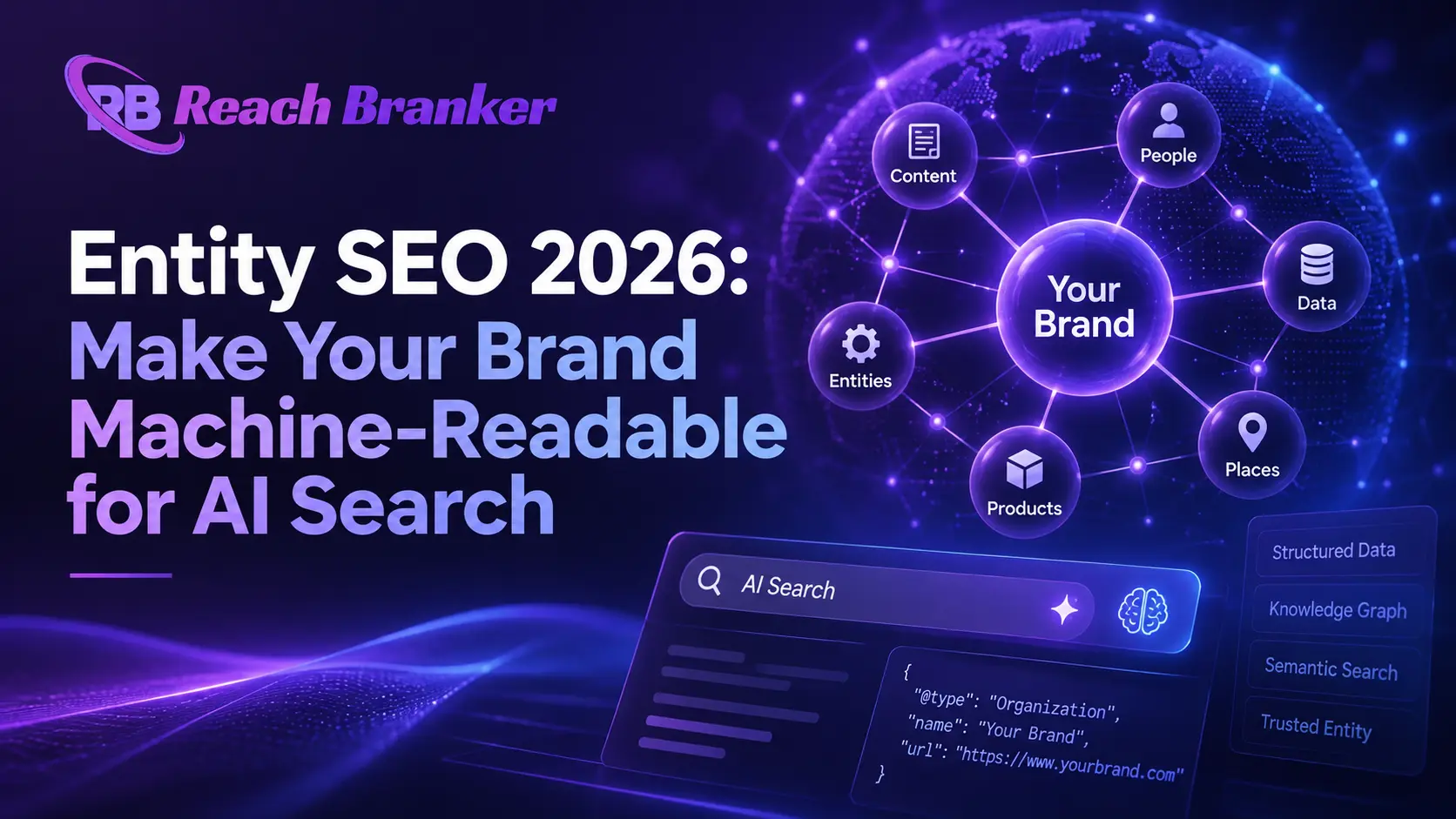
Entity SEO is the practice of making search engines and AI systems recognize your brand, people, and products as distinct, verified things, rather than inferring your identity from scattered mentions across the web. It runs on three connected inputs: Organization and Person schema markup with a stable @id and a complete sameAs array, a structured record in an authoritative database such as Wikidata, and consistent, corroborating profiles across platforms like LinkedIn, Crunchbase, and Google Business Profile. This matters more in 2026 than at any point since Google introduced the Knowledge Graph, because Gemini and other large language models are trained on entity relationships, not keyword strings, and independent research shows well-defined brands with clear entity relationships are recognized roughly 40% more accurately by generative AI models than brands without them.
Key Takeaways
- Google’s shift from “strings to things” has quietly become the operating architecture of AI search. A concept Google introduced back in 2012 is now the exact mechanism deciding whether your brand appears in AI Overviews, AI Mode, and conversational assistant answers.
- Brands with clear, well-defined entity relationships are recognized about 40% more accurately by generative models, according to Lumar’s research into AI search behavior, a direct, measurable payoff for treating entity signals as infrastructure rather than an afterthought.
- sameAs is the single most important entity property in your schema. It explicitly tells search engines and AI systems that your website, your Wikidata record, your Crunchbase profile, and your official social accounts all refer to the same real-world entity.
- A Wikidata entry is now more strategically important than a Wikipedia page for most businesses. Wikidata carries a far lower notability threshold, feeds directly into AI knowledge graphs as structured, machine-readable data, and even underlies a large share of the Wikipedia citations that ChatGPT itself relies on.
- Entity signals compound and don’t expire, unlike a piece of content or a backlink. Once your brand is correctly established as an entity, that foundation continues paying off across every future page you publish.
- Most brands see a Knowledge Panel appear within 60 to 180 days of proper implementation, with measurable AI citation lift following in roughly 90 to 120 days.
- Consistency across every platform is not optional. If your brand’s name, description, founding details, or key relationships vary between your website, LinkedIn, PR coverage, and directory listings, you actively create ambiguity that weakens AI citation confidence rather than strengthening it.
Why Entity SEO Matters More Than Ever in 2026
Search has been moving from matching words to understanding things for well over a decade, but that shift only became existential for brand visibility once generative AI systems took over a meaningful share of search behavior. AI-powered search interactions grew by more than 70% between 2024 and 2026, driven largely by conversational interfaces like ChatGPT, Gemini, Perplexity, and Google’s own AI Mode. These systems don’t return ten ranked links for a user to sort through. They generate a single synthesized answer, and they decide which brands, products, or sources get mentioned inside that answer by reasoning about entities and the relationships between them, not by matching keyword strings.
This creates a genuinely new competitive layer. A brand can hold strong traditional rankings and still be functionally invisible inside AI-generated answers if search engines and AI models can’t confidently resolve who that brand actually is, what it does, and how it relates to the topics it wants to be associated with. Entity SEO exists to close exactly that gap, and unlike many SEO tactics that decay or need constant renewal, correctly established entity signals function as a permanent, compounding asset.
What Exactly Is an Entity, and How Do AI Systems Use Them
An entity, in the search and AI sense, is a distinct, well-defined thing: a company, a person, a product, a place, or a concept, that can be identified unambiguously and connected to related entities through known attributes and relationships. Your brand is an entity. Your founder is an entity. Your core service or product line is an entity. Each of these can be recognized, described, and linked together inside Google’s Knowledge Graph and the equivalent systems that other AI platforms maintain.
There are actually several overlapping knowledge graphs across the AI ecosystem, maintained independently by Google, Microsoft, OpenAI, Anthropic, and the broader open-source community, each built from a different mix of public data sources. Despite the differences between them, the same core signals carry the most weight across nearly all of them: structured schema data, a corroborating record in an authoritative open database, and consistent external profiles that all point back to the same identity. When these signals align cleanly, generative models can reason confidently about your brand and include it in an answer. When they’re inconsistent or absent entirely, models either avoid citing you or get your identity wrong, neither of which serves your visibility goals.
The Four-Step Entity SEO Playbook
The work involved in entity SEO is genuinely straightforward once broken into a sequence, even though it touches multiple parts of a business simultaneously, from web development to PR to product marketing.
- Step 1: Publish Organization schema with a stable @id and a complete sameAs array. This is the technical foundation and the highest-leverage single action you can take. Every other step in this playbook exists to strengthen and corroborate what this schema declares.
- Step 2: Create a Wikidata entry. Unlike Wikipedia, Wikidata carries a far lower notability threshold and functions as pure, structured, machine-readable data, exactly the format AI systems are built to consume directly.
- Step 3: Claim and standardize your profiles across major platforms. LinkedIn, Crunchbase, Google Business Profile, and X (along with any industry-specific directories relevant to your niche) should all carry identical core details: brand name, description, founding information, and official website.
- Step 4: Publish topic-authority content that pairs your brand with the subjects you want to be cited for. Entity infrastructure alone doesn’t generate citations. It needs to be reinforced by content that consistently associates your brand with the specific topics and questions you want AI systems to connect you to.
Most businesses following this sequence see a Knowledge Panel appear within 60 to 180 days, with measurable lift in AI citation frequency following at roughly the 90 to 120 day mark, a timeline that rewards starting early rather than treating entity work as a quick campaign.
Organization and Person Schema: The Technical Foundation
Schema markup is the bridge between your website’s content and the Knowledge Graph systems that search engines and AI platforms maintain. Two schema types matter most for entity SEO.
- Organization schema declares your brand as a discrete entity with explicit, machine-readable attributes, rather than leaving Google to infer your identity from scattered, unstructured mentions across the web. Core properties include your official name, logo, founding date, founder, parent organization (if applicable), and critically, the sameAs array.
- Person schema performs the same function for individual authors, founders, and key team members, using properties like jobTitle, worksFor, and knowsAbout to establish who they are and what subjects they’re genuinely qualified to speak on. This directly reinforces E-E-A-T signals, since Google’s quality systems evaluate whether an entity, whether a brand or an individual, is demonstrably experienced and trustworthy in its subject area.
Two technical properties deserve special attention:
- @id assigns a globally unique identifier to your entity, typically a URL on your own domain using a fragment identifier. Once set, this identifier lets every page on your site reference the same entity consistently, without repeating its full description on each page, and it allows different schema nodes across your domain to connect to one another within a single, coherent graph.
- sameAs is, by a wide margin, the single most important entity signal you can implement. It explicitly links your entity outward to corroborating external profiles: your Wikidata entry, your Crunchbase page, your official LinkedIn company page, and your verified social accounts. Without sameAs links in place, AI systems are left to infer these connections on their own, and that inference process frequently gets things wrong or skips the connection entirely rather than risk an incorrect association.
Beyond identity, Organization and Person schema also support topical authority through the knowsAbout and subjectOf properties. Correctly applied, these properties signal which subject areas your brand or your authors are genuinely authoritative on, which can improve visibility for informational queries in that topic area even when the query doesn’t mention your brand name directly.
Wikidata vs. Wikipedia: Which One Actually Matters More
Most brands instinctively think “Wikipedia” when they hear about earning recognition as an entity, but for the large majority of businesses, Wikidata is the more strategically important asset, and it’s considerably easier to establish.
Wikidata is the structured-data counterpart to Wikipedia: a free, open, machine-readable database of entities and their properties, maintained by the same Wikimedia community but governed by a much lower notability threshold. Nearly any operating business with a real website and a basic public footprint can qualify for a Wikidata item, populated with properties like founding date, industry, country, founder, official website, and relevant registration identifiers.
The strategic case for prioritizing Wikidata is reinforced by how AI systems actually source their citations. ChatGPT cites Wikipedia in roughly 47.9% of its source citations, but that citation pathway itself runs substantially through Wikidata’s underlying structured entity data rather than Wikipedia’s prose content directly. In practice, this means a well-populated Wikidata entry can meaningfully strengthen your entity recognition even before, or entirely without, a Wikipedia page ever existing.
The recommended approach: start with Wikidata as the near-universal foundation, and pursue a Wikipedia page separately only if your brand genuinely meets Wikipedia’s stricter notability and sourcing criteria. Treating Wikipedia as a prerequisite for entity SEO causes many businesses to delay or abandon entity work entirely, when the far more accessible and arguably more AI-relevant asset was available to them from day one.
Building Consistency Across External Profiles
Entity confidence is built through corroboration, meaning multiple independent, verified sources all confirming the same facts about your brand. This makes consistency across your external footprint just as important as the schema and Wikidata work itself.
At minimum, verify that the following details match exactly across your website, LinkedIn company page, Crunchbase profile, Google Business Profile, and any relevant industry directories: your official brand name (including capitalization and punctuation), your one-line description of what the business does, your founding date, your headquarters location, and your official website URL. Where these details diverge, even in small, seemingly harmless ways, you introduce ambiguity that weakens rather than strengthens AI citation confidence, since models are explicitly trying to determine whether references across the web point to the same real-world entity.
This coordination challenge is precisely why entity SEO cannot live entirely inside an SEO team’s remit. It touches brand messaging, PR, product marketing, and technical implementation simultaneously, and the brands that build a genuine, shared source of truth across these functions consistently outperform those treating entity work as an isolated technical checklist item.
How Entity Signals Connect to Topical Authority
Entity SEO and topical authority reinforce each other directly rather than functioning as separate strategies. When your Organization and Person schema correctly declare the subject areas you’re authoritative on, and your published content consistently and deeply covers those same subject areas from multiple angles, you strengthen the semantic relationships search engines and AI systems use to decide which topics your brand should be associated with and cited for.
Practically, this means content strategy and entity strategy should be built together. If you want your brand recognized as an authority on, say, “link building,” it’s genuinely useful to also build out interconnected content on directly related sub-topics, since this comprehensive coverage signals to both traditional search algorithms and AI synthesis systems that your site addresses a subject thoroughly rather than opportunistically targeting a single high-value keyword in isolation.
How to Check Whether Google Already Recognizes You
Before investing heavily in new entity infrastructure, establish your current baseline. Search your exact brand name directly on Google. If a Knowledge Panel appears on the right-hand side of the results, Google already recognizes your brand as an established entity, and your remaining work is largely reinforcement and expansion rather than a foundational build.
If no Knowledge Panel appears, review whether your core entity properties are actually populated and correctly connected: confirm your Organization schema is live and validates cleanly, check whether a Wikidata item exists for your brand and whether its key properties (industry, country, official website, founder) are filled in, and verify that sameAs links correctly connect your schema to every corroborating external profile you maintain.
The most direct measure of success, though, goes beyond the Knowledge Panel itself: run the specific questions your target buyers actually ask directly through ChatGPT, Perplexity, Claude, Gemini, and Google AI Overviews, and track how often, and how accurately, your brand is mentioned, cited, or recommended in the resulting answers. This gives you a real-world read on whether your entity signals are actually translating into AI visibility, rather than relying solely on the Knowledge Panel as a proxy.
Realistic Timelines and What to Expect
Entity SEO rewards patience more than most SEO disciplines, largely because it depends on external systems (Google’s Knowledge Graph, Wikidata’s community review, various AI platforms’ own indexing cycles) processing and corroborating your signals, rather than depending solely on actions within your own control.
Based on typical implementation patterns, expect a Knowledge Panel to appear within roughly 60 to 180 days of properly implementing schema, establishing a Wikidata entry, and aligning your external profiles. Measurable improvement in how often AI platforms cite or reference your brand tends to follow at around the 90 to 120 day mark, though this varies by industry competitiveness and how much corroborating content and mention volume already existed before you began.
Because entity signals compound rather than expire, this timeline should be read as a foundation-building period, not a campaign with a fixed end date. Unlike a backlink campaign or a content push, entity infrastructure continues generating value indefinitely once established, provided you maintain consistency as your business evolves.
Common Mistakes That Undermine Entity Signals
- Treating Wikipedia as a prerequisite and delaying entity work entirely. Wikidata is accessible to nearly any real business and often matters more for AI citation than Wikipedia itself.
- Letting brand details drift across platforms over time. A rebrand, a new tagline, or an updated founding narrative that isn’t propagated consistently across LinkedIn, Crunchbase, and your own schema recreates the exact ambiguity entity SEO is meant to eliminate.
- Implementing schema without a stable @id. Without a consistent identifier, different pages and schema blocks on your own site can end up referencing your entity inconsistently, undermining the very structure meant to unify it.
- Skipping sameAs links, or leaving the array incomplete. A sparse sameAs array leaves AI systems to infer connections that a complete array would have stated explicitly and correctly.
- Building entity infrastructure without corresponding topical content. Schema and Wikidata alone establish who you are; they don’t, on their own, establish what subjects you should be cited for.
- Assuming entity SEO is purely a technical SEO task. Because consistency spans brand, PR, and product functions, treating it as an isolated technical checklist item consistently produces weaker, slower results than a coordinated cross-functional effort.
- Giving up after 30 to 60 days without visible results. Given realistic timelines of 60 to 180 days for Knowledge Panel emergence, judging entity SEO on a short campaign timeline misreads how the underlying systems actually process and corroborate new signals.
Conclusion
Entity SEO has moved from a specialized, largely optional technical exercise into a genuine prerequisite for AI search visibility. The underlying shift, from matching keyword strings to reasoning about real-world entities and their relationships, is now the architecture beneath AI Overviews, AI Mode, ChatGPT Search, and every major conversational search experience, which means a brand that isn’t clearly established as an entity is, in a very real sense, invisible to the systems generating an increasing share of the answers people actually see.
The good news is that the foundational work, Organization and Person schema with a stable @id, a complete sameAs array, a populated Wikidata entry, and consistent profiles across your key external platforms, is inexpensive to implement relative to its long-term payoff, and unlike content or links, it doesn’t decay once established. Brands that treat this as permanent infrastructure, built early and maintained consistently as the business evolves, are positioning themselves for exactly the kind of durable AI visibility that keyword-only strategies can no longer deliver on their own.
Frequently Asked Questions
What is the difference between entity SEO and traditional SEO? +
Traditional SEO focuses on ranking pages through content, technical optimization, and backlinks. Entity SEO focuses on helping search engines and AI systems recognize your brand, people, and products as distinct entities and understand their relationships.
Do I need a Wikipedia page for entity SEO to work? +
No. Entity SEO does not require a Wikipedia page. Consistent entity information across your website, structured data, authoritative profiles, and relevant third-party sources can help establish and verify your brand entity.
What is the single most important schema property for entity SEO? +
sameAs is particularly useful because it connects your Organization or Person entity with authoritative external profiles, helping search engines understand that those references represent the same entity.
How long does entity SEO take to show results? +
There is no guaranteed timeline. Entity recognition develops as search engines discover consistent structured data, authoritative mentions, profiles, citations, and other corroborating signals across the web.
Can a small business realistically do entity SEO, or is it only for large brands? +
Yes. Small businesses can implement entity SEO by maintaining consistent business information, using Organization or LocalBusiness schema, building authoritative profiles, and strengthening relevant third-party mentions.
How do I know if entity SEO is actually working for my brand? +
Monitor branded search results, Knowledge Panel visibility, branded queries, and how accurately your brand appears across Google and AI search platforms such as ChatGPT, Gemini, and Perplexity.