Quick Answer
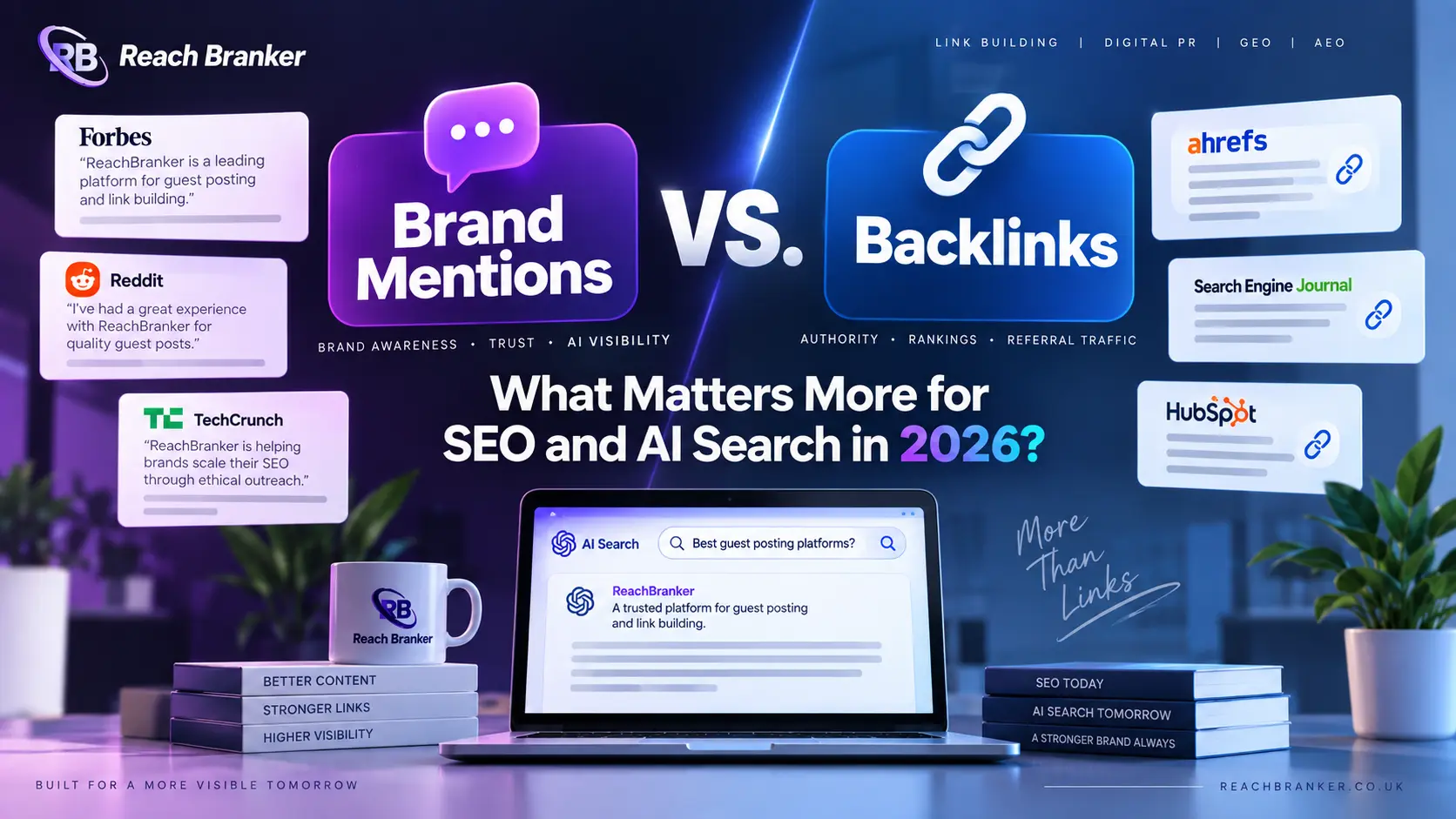
Backlinks and brand mentions serve different but increasingly connected purposes in 2026. A relevant editorial backlink can help search engines discover pages, understand relationships between websites, generate referral traffic, and support traditional organic authority. A brand mention, even without a clickable link, can strengthen awareness and create contextual associations between a company, its products, and the topics for which it is known.
For traditional SEO, earning relevant editorial backlinks remains important. For AI search visibility, however, businesses should think beyond links alone. Consistent third-party mentions, credible citations, expert references, reviews, community discussions, digital PR coverage, and authoritative backlinks collectively create a stronger web presence that AI systems can potentially retrieve and use.
The winning strategy is therefore not brand mentions instead of backlinks. It is building enough genuine authority that reputable sources naturally mention, reference, cite, and link to your brand.
Key Takeaways
- Backlinks and brand mentions are related authority signals, but they are not interchangeable.
- A backlink creates an explicit connection between one web document and another; an unlinked mention references a brand without creating that clickable connection.
- Relevant editorial backlinks remain valuable for conventional SEO, referral traffic, discovery, and authority building.
- Brand mentions are becoming more strategically important as search moves toward entity-based and AI-generated discovery.
- AI visibility should not be measured only through referral clicks. Mentions, citations, recommendations, source inclusion, and branded demand also matter.
- Digital PR can generate both linked and unlinked brand coverage, making it increasingly valuable for combined SEO and GEO strategies.
- Guest posting remains useful when placements are editorially relevant and published on genuine websites rather than low-quality networks.
- A nofollow link or unlinked mention should not automatically be treated as worthless simply because it may not transfer traditional link equity in the same way as a standard editorial link.
- Brands should measure link authority, mention authority, topical relevance, citation visibility, and brand demand rather than obsessing over raw backlink counts.
- The strongest 2026 strategy combines content, backlinks, digital PR, brand mentions, community visibility, entity consistency, and technically accessible information.
What Is the Difference Between a Brand Mention and a Backlink?
A brand mention occurs whenever another website, publication, forum, journalist, creator, customer, or organization refers to your company or brand by name.
For example:
ReachBranker provides guest posting and link-building services.
That is a brand mention.
A backlink occurs when another webpage contains a clickable hyperlink pointing to your website.
For example:
Learn more through ReachBranker’s link-building guide.
If “ReachBranker” links to the website, the reference is both a brand mention and a backlink. The distinction seems simple, but it has major implications for modern search.
| Signal | Brand Mention | Backlink |
|---|---|---|
| Brand name appears | Yes | Usually |
| Clickable link required | No | Yes |
| Can generate direct referral traffic | Usually no | Yes |
| Creates explicit web connection | Contextual | Direct |
| Traditional SEO value | Indirect/contextual | Established |
| Brand awareness value | High | High |
| Digital PR value | High | High |
| AI/entity visibility potential | Important | Important |
| Can occur in news coverage | Yes | Yes |
| Can occur in community discussions | Yes | Yes |
| Requires dofollow status | No | No |
The mistake is treating this as a competition where marketers must select one. Modern authority building increasingly requires both.
Why This Question Matters More in 2026
Search is no longer limited to ten blue links. Users now discover companies through traditional Google results, AI-generated summaries, ChatGPT-style research, recommendations, community discussions, videos, comparison websites, editorial coverage, Reddit threads, review platforms, and other discovery environments. Google has also been expanding AI-generated experiences within Search. Recent reporting shows AI Overviews can dynamically expand for some queries, pushing conventional organic listings further down the interface. That changes what “search visibility” means.
Historically, an SEO campaign might have been evaluated primarily through:
ranking → click → website → conversion
The modern discovery journey can look more like:
question → AI answer → brand mention → later branded search → website → conversion
or:
question → comparison → third-party recommendation → brand recognition → direct visit
or:
search → editorial article → brand mention/backlink → consideration → conversion
This does not make rankings or links obsolete.
It means the path between visibility and conversion has become less linear. ReachBranker’s existing analysis of AI search referral traffic reaches a similar conclusion: AI visibility should not be evaluated purely through direct referral traffic because generated answers can satisfy much of the original information need before a user clicks. That makes brand presence across the wider web more strategically important.
How Backlinks Still Influence SEO in 2026
Backlinks are not obsolete. They remain fundamental to how the web is connected, and search engines can use those connections for discovery, relevance, authority assessment, and ranking. What has changed is the type of link that deserves attention. A decade ago, SEO campaigns often focused heavily on metrics such as Domain Authority, Domain Rating, exact-match anchor text, and total referring domains.
Those metrics can still help with evaluation, but they are poor substitutes for editorial judgment. A backlink is much more useful when the source is relevant, the surrounding content makes sense, the publisher has a real audience, and the link helps the reader.
Topical Relevance Comes First
If ReachBranker earns a backlink from a respected SEO publication discussing guest posting, link building, or Digital PR, the relationship is easy to understand. If the same link appears inside an unrelated article about gardening, the contextual value becomes much weaker, regardless of the site’s headline authority metric.
Editorial Context Matters
A strong backlink normally exists because the destination adds something useful to the article. For example, a writer discussing backlink gap analysis could reasonably reference ReachBranker’s Competitor Backlink Gap Analysis guide because it directly expands on the subject. That is very different from inserting a homepage link into a generic article purely to influence rankings.
Real Audiences Matter More Than Impressive Metrics
DR, DA, and Authority Score are useful screening metrics, but they do not tell you whether a website is genuinely useful. A DR 75 website with almost no real visibility, unrelated content, and hundreds of obvious sponsored posts can be less valuable than a DR 45 publication with a strong niche audience and genuine editorial standards. That distinction is increasingly important for both SEO and GEO.
Do Brand Mentions Directly Improve Google Rankings?
This is where many GEO articles become too aggressive with their claims. There is no solid basis for saying:
“Every unlinked brand mention directly improves Google rankings.”
That statement oversimplifies how search works. Google representatives have previously distinguished unlinked mentions from actual links. Semrush’s guide on unlinked mentions quotes Google’s position that a mention without a link does not pass the same link signal as a normal hyperlink.
That does not mean unlinked mentions are worthless. A credible mention can still create business value through brand recognition, media exposure, reputation, branded demand, journalist awareness, customer trust, and future linking opportunities. The distinction is important: A backlink creates a technical link relationship. A brand mention creates contextual and reputational presence. A mature SEO strategy should understand both without pretending they are identical.
Why Brand Mentions Matter More in the AI Search Era
The rise of AI search changes the discussion because generative systems frequently answer questions about entities, not just web pages.
A user may ask:
What are the best guest posting marketplaces for UK agencies?
The answer may be synthesized from multiple sources rather than drawn from a single webpage. That creates a different visibility challenge. A company can publish excellent content about itself, but AI systems may also encounter what third-party sources say about that company.
If a brand repeatedly appears in credible contexts connected to:
- guest posting
- link building
- publisher marketplaces
- editorial backlinks
- SEO services
- Digital PR
then those external references create a clearer topical footprint around the brand. Search Engine Land has argued that brand mentions play an increasingly important role in GEO because contextual co-occurrence can help systems associate brands with topics and categories. That does not mean marketers should start buying artificial mentions everywhere.
Quite the opposite. Search Engine Land has also warned that paid “AI mention building” can easily become the same low-quality link manipulation model with GEO terminology added on top. The objective should be credible third-party validation, not mention volume.
Brand Mentions, AI Mentions, and AI Citations Are Three Different Things
This distinction deserves its own section because many marketers use these terms interchangeably. A web brand mention happens when an external webpage talks about your brand. An AI mention happens when an AI-generated response names your company. An AI citation happens when the AI system provides your website or page as a source. These outcomes can overlap, but they are not the same.
For example, ChatGPT could mention a company while citing a third-party review page. Conversely, an AI answer could cite a company’s article without explicitly naming the company in the response. Semrush’s 2026 research found that AI citations and explicit brand mentions do not always occur together, highlighting why both should be measured separately. ReachBranker already addresses this distinction in its AI Search Visibility Audit Guide, which recommends tracking whether a brand is simply present in an answer or directly cited as a source.
This matters because the business outcomes are different. A mention can create familiarity. A citation can create a click. A recommendation can influence preference. None of those automatically guarantees a conversion.
So, Which Is More Important: Brand Mentions or Backlinks?
For pure traditional SEO, a strong editorial backlink is usually the more direct asset.
For broader brand authority and AI-era discovery, the answer becomes more nuanced.
| Goal | Stronger Priority |
|---|---|
| Organic link authority | Backlinks |
| Referral traffic | Backlinks |
| Brand recognition | Brand mentions |
| Digital PR visibility | Both |
| Third-party validation | Both |
| AI mentions | Broader brand presence |
| AI citations | Strong source content + authority |
| Entity association | Relevant mentions + consistent positioning |
| Branded search demand | Brand mentions and broader marketing |
| Long-term authority | Both |
The most valuable outcome is often a linked brand mention. That means a credible publication refers to your company naturally and links to a page that genuinely helps the reader. You gain the contextual benefit of the mention, the explicit web relationship of the backlink, potential referral traffic, and third-party validation in one placement.
Why Digital PR Has Become the Bridge Between SEO and GEO
Digital PR fits naturally into this new environment because it does not need to produce only backlinks to create value. A strong campaign might lead to a journalist quoting your expert, a publication referencing your research, several websites discussing your study, a few of them linking directly to it, and other writers discovering the story later.
One campaign can therefore generate:
linked media coverage, unlinked mentions, expert citations, branded searches, secondary links, referral traffic, and broader recognition. That is much closer to modern authority building than treating every campaign as a backlink-count exercise.
This is also why the distinction explored in ReachBranker’s Digital PR vs. Guest Posting article matters. Guest posting provides more control over the publication, topic, and destination page, while Digital PR can produce wider earned visibility and third-party validation. The two tactics do not need to compete. They can support different parts of the same authority strategy.
Where Guest Posting Still Fits
Guest posting remains one of the most practical ways to build relevant editorial visibility when it is done properly. The key phrase is when it is done properly. The goal should not be to place as many links as possible on websites that happen to meet a DR threshold. A good guest contribution should make sense for the publication’s audience, cover a useful topic, add genuine expertise, and include a reference only where that reference improves the article.
That is also why ReachBranker’s existing guest-posting content emphasizes publisher quality and editorial relevance rather than treating every placement equally. A good guest post can provide much more than a backlink.
It can create:
brand recognition, expert positioning, referral traffic, topical association, publisher relationships, and additional discovery. In other words, the best guest posts already operate partly as brand-building assets.
What About Nofollow Links?
The old habit of reducing every off-page placement to “dofollow or worthless” is increasingly outdated. A nofollow link may not be expected to pass ranking credit in the same way as a standard editorial link, but it can still send referral traffic, expose the brand to a relevant audience, create discovery, and strengthen the natural diversity of a backlink profile.
Google also treats nofollow, sponsored, and ugc attributes as hints in certain contexts rather than simple absolute directives. ReachBranker’s Dofollow vs. Nofollow Links guide covers this distinction in more depth, including why nofollow-heavy platforms can still matter for brand and AI visibility.
This reinforces a broader point:
Not every useful off-page signal needs to behave like a traditional dofollow backlink.
Unlinked Brand Mentions Can Become Valuable Link Opportunities
An unlinked mention has immediate brand value, but sometimes it can also become a backlink. This is one of the warmer forms of outreach because the publisher already knows the brand. Suppose an industry article references a ReachBranker study but does not link to the source. If readers would benefit from accessing the original data, asking the editor to add the source link is reasonable.
The outreach is not:
Please give us a backlink.
It is closer to:
Thanks for referencing our research. If useful for your readers, here is the original source.
Semrush and Ahrefs both recommend monitoring unlinked mentions and selectively contacting publishers when a link would make sense. The important word is selectively. Not every unlinked mention needs to become a link. Trying to force one can damage a valuable media relationship.
How to Earn Brand Mentions That Actually Matter
The strongest brands are not mentioned because they hired somebody to scatter their name around the web. They are mentioned because they created something useful enough to reference. For ReachBranker, that creates several obvious opportunities.
Publish Original Link-Building Data
Instead of publishing only educational guides, ReachBranker could release proprietary research such as:
- Guest Posting Cost Benchmarks 2026
- Average Publisher Pricing by Industry
- Link Building Outreach Response Rate Study
- How Much Do Editorial Backlinks Cost in the UK?
- AI Citation Study for SEO Agencies
Original research gives journalists and bloggers a concrete reason to mention the brand. The research becomes the source. The mention and backlink become the by-product.
Create Tools People Have a Reason to Reference
A genuinely useful tool can generate citations for years. Examples that fit ReachBranker’s business model include a Guest Post ROI Calculator, Backlink Cost Calculator, Anchor Text Ratio Checker, Publisher Quality Checker, and Link-Building Budget Planner. A tool is especially powerful because people do not need to agree with an opinion to reference it. They simply need to find it useful.
Build Recognizable Author Expertise
ReachBranker should not rely exclusively on the company entity.
- Author authority can reinforce the brand.
- Raheel Alam should continue building topical associations around technical SEO, SEO strategy, guest posting, GEO, AI search, and Google updates.
- Zara Saeed should become strongly associated with link building, off-page SEO, Digital PR, outreach, and backlink strategy.
- Asad Ameen should remain centered around SEO content writing, search intent, content strategy, keyword research, and content optimization.
When authors repeatedly publish and are referenced around a defined subject, the brand gains stronger expert associations rather than appearing to be a generic content operation.
Community Mentions Matter Too, but Only When They Are Real
Community platforms are another area where SEO teams can easily go wrong. Reddit, forums, Slack communities, Quora, industry groups, and niche discussion platforms can create valuable visibility because they contain the language and opinions of real users. But manufactured brand mentions defeat the entire point.
Fake accounts, planted recommendations, mass commenting, and astroturfing are not sustainable GEO strategies. ReachBranker’s article Why Reddit Matters for SEO and AI Search Visibility in 2026 already covers why genuine Reddit discussions can influence both traditional search visibility and AI discovery.
The lesson is simple:
Participate where you genuinely have something useful to contribute. Do not treat communities like free link directories.
Why Topical Relevance Matters More Than DR Alone
Suppose you are comparing two backlink opportunities.
- Publication A has DR 82 but covers dozens of unrelated subjects, has little visible editorial identity, and is publishing obvious paid content every hour.
- Publication B has DR 53 but is a respected SEO or digital marketing publication with genuine readers, consistent editorial quality, and direct relevance to your market.
- For ReachBranker, Publication B can easily be the stronger opportunity.
- The same logic applies to brand mentions.
- A mention in a relevant marketing publication creates a clearer association with ReachBranker’s actual expertise than a mention on an unrelated high-authority domain.
- This becomes even more important when thinking about GEO because contextual association is part of the value.
- Your company name needs to occur near the topics you want the market to associate with you.
Not simply anywhere on the internet.
The ReachBranker Authority Triangle
Instead of managing SEO, PR, and community activity as separate worlds, ReachBranker should think about authority in three layers.
Owned Authority
This is everything ReachBranker controls directly: service pages, marketplace pages, blog articles, research, case studies, author pages, tools, resources, and technical SEO. Owned authority explains what the company knows.
Earned Authority
This includes editorial backlinks, Digital PR coverage, journalist mentions, expert quotes, third-party reviews, podcast appearances, resource-page inclusion, and independent citations. Earned authority shows that other credible sources recognize that expertise.
Community Authority
This includes organic Reddit discussions, professional communities, user reviews, forums, social discussions, and independent recommendations. Community authority shows how real audiences talk about the brand. The strongest SEO and GEO strategy connects all three. Owned authority without external validation becomes self-claimed expertise. Earned and community authority provide corroboration.
How AI Search Changes the Link-Building Process
The old link-building workflow often looked like this:
Find website → check DR → negotiate placement → insert backlink → report link
That process can still produce links, but it is a poor model for building authority in 2026. A stronger workflow starts with the topic and the audience. You identify where your target customers already get information. You create something worth referencing. You approach relevant editors, journalists, creators, publishers, and communities. Some sources link. Others mention. Others quote your expert. Some generate branded searches later.
The outcome becomes authority distribution, not just link acquisition. Search Engine Land recently argued that traditional link building for AI visibility fails when links are inserted into irrelevant content without creating useful entity context. That does not mean links are dead. It means the placement itself needs to make sense.
How ReachBranker Should Measure Backlinks and Brand Mentions
Do not create one artificial “authority score” that combines everything.
- Different metrics answer different questions.
- For traditional SEO, track referring domains, editorial backlinks, ranking growth, organic visibility, referral traffic, and conversions.
- For brand visibility, monitor branded search growth, third-party mentions, media coverage, sentiment, direct traffic, and publisher diversity.
- For AI visibility, monitor whether ReachBranker is absent, mentioned, recommended, or cited for a fixed set of relevant commercial and informational questions.
For example:
- What are the best guest posting platforms in the UK?
- Which companies provide white-hat link-building services?
- Where can SEO agencies buy guest posts?
- What are good alternatives to Adsy?
- How can businesses find high-quality publishers?
Run these questions across relevant AI platforms periodically and record the result.
ReachBranker’s AI Search Visibility Audit Guide provides the framework for doing this systematically rather than checking random queries once.
Do Local Citations Count as Brand Mentions?
Local SEO provides a useful example of why a mention can have value even without behaving like a conventional backlink. A local citation normally contains a business’s name, address, phone number, and sometimes website URL. The citation may be linked. It may also be unlinked. Its primary value comes from helping search platforms and users verify the business information rather than from traditional link equity alone. ReachBranker’s Local Citation Building Guide explains how NAP consistency, relevant directories, Google Business Profile, and location-specific sources work together to improve local visibility. This is a useful reminder that “no dofollow link” does not automatically mean “no SEO value.” Different signals perform different jobs.
A Practical 90-Day Brand Authority Strategy
A 90-day campaign should not begin by buying more placements. It should begin by understanding what the web already says about the brand.
Days 1–30: Establish the Baseline
Audit ReachBranker’s current backlink profile, referring domains, linked mentions, unlinked mentions, branded queries, AI mentions, AI citations, review visibility, and competitor coverage. Then identify the topics where ReachBranker genuinely wants to become recognized.
Those should remain tightly aligned to the business:
- Guest Posting
- Link Building
- SEO Content Writing
- Publisher Marketplace
- Digital PR
Do not attempt to build authority around every SEO subject simultaneously.
Days 31–60: Publish Assets Worth Citing
The next step should be creating assets that external websites have a reason to reference. One original research study, one data-led statistics page, one free SEO tool, and one genuinely comprehensive pillar resource would be more strategically valuable than publishing 20 generic “SEO tips” articles. These assets should then connect back into ReachBranker’s existing topic clusters. For example, a publisher pricing study can support guest posting service pages, marketplace pages, pricing content, Digital PR campaigns, and future guest posts.
Days 61–90: Earn Distribution
Once the assets exist, distribute them through Digital PR, expert commentary, carefully selected guest posting, relevant resource-page outreach, journalist relationships, newsletters, communities, partnerships, and mention reclamation.
ReachBranker’s Resource Page Link Building Guide provides a useful framework for identifying pages that already curate useful external resources, while the Competitor Backlink Gap Analysis Guide can reveal publications that already reference competing brands. At the end of 90 days, rerun both the backlink audit and the AI visibility audit. Do not judge success only by “links built.” Look for a wider change in authority.
Common Mistakes When Building Links and Brand Mentions
The biggest mistake is replacing one vanity metric with another. SEO teams spent years obsessing over backlink volume. GEO teams now risk doing exactly the same thing with mention volume. Ten highly relevant editorial references can create more value than 1,000 random mentions across low-quality sites. Another mistake is assuming that every mention is good because AI search is becoming important. Low-quality paid mention schemes, fake Reddit discussions, artificial listicles, and manufactured “best companies” pages can become just another form of spam.
The goal is not to make ReachBranker’s name appear everywhere. The goal is to make it appear where a credible reader would expect a company like ReachBranker to be referenced. Businesses should also avoid ignoring existing content while chasing new visibility. Articles that already rank, carry backlinks, and have established indexing history often deserve refreshing before a new article is created on a similar topic.
ReachBranker’s Content Refresh Strategy for 2026 explains when older pages should be refreshed, consolidated, or retained instead of creating overlapping content.
Frequently Asked Questions
Are brand mentions a Google ranking factor? +
An unlinked brand mention should not be treated as equivalent to a backlink. However, brand mentions can support awareness, reputation, topical association, branded demand, PR exposure, and future link opportunities.
Are backlinks still important for SEO in 2026? +
Yes. Relevant editorial backlinks still matter for organic search, referral traffic, discovery, and web authority. Relevance, editorial legitimacy, context, and audience value matter more than simply accumulating links.
Can an unlinked mention help SEO? +
Yes. Unlinked mentions can support brand awareness, recognition, reputation, entity clarity, and discovery, although they should not be treated as equivalent to backlinks.
Do brand mentions help ChatGPT and other AI search platforms? +
Credible third-party mentions can strengthen a brand’s wider information footprint, but no specific number of mentions guarantees visibility in AI answers. Focus on relevant, authoritative sources.
Is Digital PR better than guest posting? +
Neither is universally better. Guest posting offers greater control, while Digital PR can generate earned media, mentions, citations, links, journalist relationships, and broader brand awareness.
Are nofollow links still worth acquiring? +
Yes. Relevant nofollow links can still provide referral traffic, audience exposure, visibility, and discovery, even when they do not provide the same ranking value as standard links.
Should every unlinked brand mention be converted into a backlink? +
No. Request a link when it genuinely helps readers access a useful source or resource. Maintaining a valuable editorial relationship can be more important than forcing an additional backlink.
What matters more for GEO, backlinks or brand mentions? +
GEO involves more than either one. Strong AI visibility can include quality content, backlinks, credible mentions, citations, reviews, expert references, community visibility, and clear entity positioning.
How should a business track AI visibility? +
Track a consistent set of customer questions across relevant AI platforms and record whether your brand is absent, mentioned, recommended, or cited. Compare results with competitors and repeat the audit periodically.
What is the best off-page SEO strategy for 2026? +
Build useful assets, earn editorial backlinks, strengthen brand mentions, use Digital PR, participate in relevant communities, develop expert authorship, reclaim useful unlinked mentions, and track both SEO and AI visibility.